
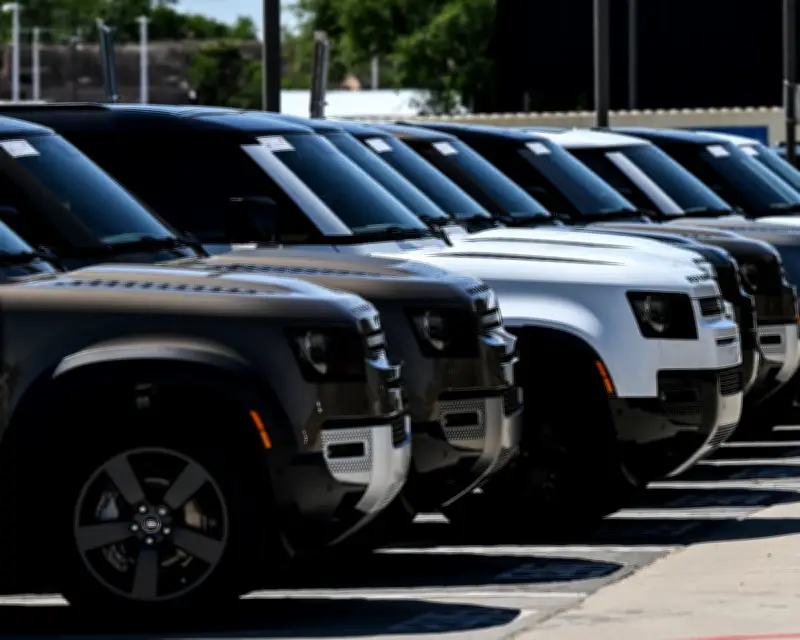
Jaguar Land Rover has announced plans to produce more hybrid vehicles as part of a strategic focus on growth in the United States, marking a further retreat from its previously announced all-electric strategy. The British carmaker informed investors on Wednesday that it would offer petrol and hybrid versions of new models, including smaller SUVs that were originally slated to be exclusively electric.
US Market Ambitions
The company aims to make its US sales equivalent to the current size of the entire JLR business, a shift that implies selling an additional 250,000 vehicles to affluent American customers. This move comes as automakers worldwide delay their transition to electric vehicles (EVs) amid government policy changes and reduced incentives, particularly in the US under President Donald Trump.
JLR executives are banking on an unprecedented wave of inherited wealth in the US over the coming decades to drive demand for luxury vehicles like the Range Rover, which starts at over £107,000 ($143,000). Chief executive PB Balaji stated, “To truly manifest the power of our brands, we will increase our focus on North America, our biggest market.”
Production Adjustments
JLR will modify its manufacturing plans to produce hybrid versions of its smaller SUVs at the Halewood factory in Merseyside, as well as a hybrid version of the bestselling Defender, made in Slovakia. This decision reverses a 2023 plan to make Halewood an all-electric facility. Hybrids, which rely primarily on petrol engines with limited battery assistance, offer minimal carbon savings.
The company, still recovering from a severe cyber-attack last autumn, targets double-digit revenue growth over the medium term and will maintain its £18bn investment plan for 2024-2029. Exports from the UK to the US face 10% tariffs, and JLR is exploring potential manufacturing in the US, possibly in collaboration with Stellantis.
Impact on UK EV Policies
JLR’s slower shift to electric vehicles has influenced the UK government’s decision to soften its EV sales targets. The zero emission vehicle (ZEV) mandate now requires 80% of sales to be battery electric by 2030, but sources indicate this could be reduced to 50% following industry lobbying. JLR has already delayed the launch of its electric Range Rover by a year, and orders for the first electric Jaguar under a relaunched brand are not expected until 2027.




