
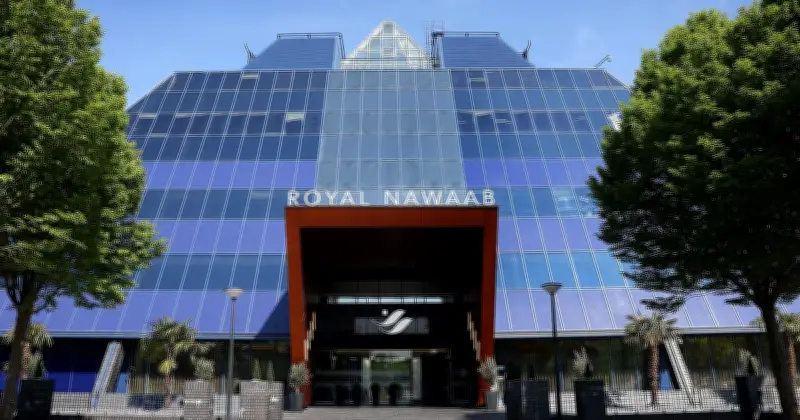
Motorists traveling around Greater Manchester may have spotted a striking blue pyramid rising above the M60 and wondered exactly what it is. While its futuristic appearance has prompted comparisons with everything from a giant UFO to an Egyptian monument, the building is actually home to what is billed as the world's largest curry restaurant.
What is inside the M60's giant blue pyramid?
The vast Royal Nawaab complex in Stockport welcomes thousands of diners every week and has become one of the region's most unusual landmarks. The restaurant occupies a huge glass-clad pyramid beside the motorway and employs around 200 staff. Its centerpiece is an all-you-can-eat buffet stretching 165 feet and offering around 180 dishes, with customers helping themselves from rows of steaming serving stations. According to the business, as many as 2,000 diners can visit on a busy evening. The operation also gets through around 15,000 chillies every week, alongside thousands of poppadoms, more than a tonne of rice, and huge quantities of meat and ingredients.
Who is behind Royal Nawaab?
Owner Mahboob Hussain describes the venue as more than simply a restaurant. 'Curry house doesn't nearly do it justice,' he said, describing it instead as a destination venue. Mr. Hussain moved to Britain from Pakistan with his family as a teenager and went on to build a successful career in the restaurant industry. After operating buffet restaurants in Bradford and later in southern England, he took on the Stockport pyramid and embarked on an ambitious redevelopment project. 'I wanted to prove a point that in this country we can still produce and manufacture to a high standard,' he said. 'We don't have to go to China for everything. All the tiles come from Preston, the furniture from Knutsford and so on. I wanted to employ as many local tradesmen as possible.'
How did the building become a restaurant?
Before becoming Royal Nawaab, the pyramid served as a Co-op bank call centre. Constructed in 1992, it was originally intended to form part of a larger development featuring several pyramids, although those plans never materialized after financial difficulties hit the project. The building later stood empty for years and gained a reputation locally as an abandoned landmark. When Mr. Hussain acquired the site, he said it was largely stripped out and in poor condition. Labourers reportedly filled hundreds of skips while clearing the building ahead of a transformation costing around £15 million. Today the interior features marble floors, chandeliers, and large event spaces designed to host weddings and corporate functions.
How big is the operation?
Alongside the restaurant, the building includes facilities capable of hosting wedding celebrations for up to 1,200 guests. A further floor is used for business events, while additional facilities are planned for the future. The kitchen operation is equally vast. More than 30 chefs work in an open kitchen while dozens more prepare food behind the scenes. Many dishes are based on recipes developed by Mr. Hussain himself, who continues to oversee day-to-day operations. 'I love it here in the kitchen,' he said. 'I've never lost my love for this.'
How much food does Royal Nawaab serve?
The scale of the operation is reflected in its weekly shopping list. The restaurant says it uses around 1,500 kg of rice every week, serves roughly 10,000 poppadoms, and consumes the equivalent of around 1,000 chickens. Its food bill is said to reach approximately £100,000 each week. To keep waste under control, the business uses advance booking data to adjust production levels and predict demand. Marketing director Bilal Jogi said transforming the pyramid into its current form had been a significant gamble. 'It was a humongous undertaking, a huge risk,' he said. 'It was just after Covid and hospitality was dying.' Several years on, however, the distinctive blue pyramid has become one of Greater Manchester's most recognizable buildings and one of the region's busiest dining destinations.




