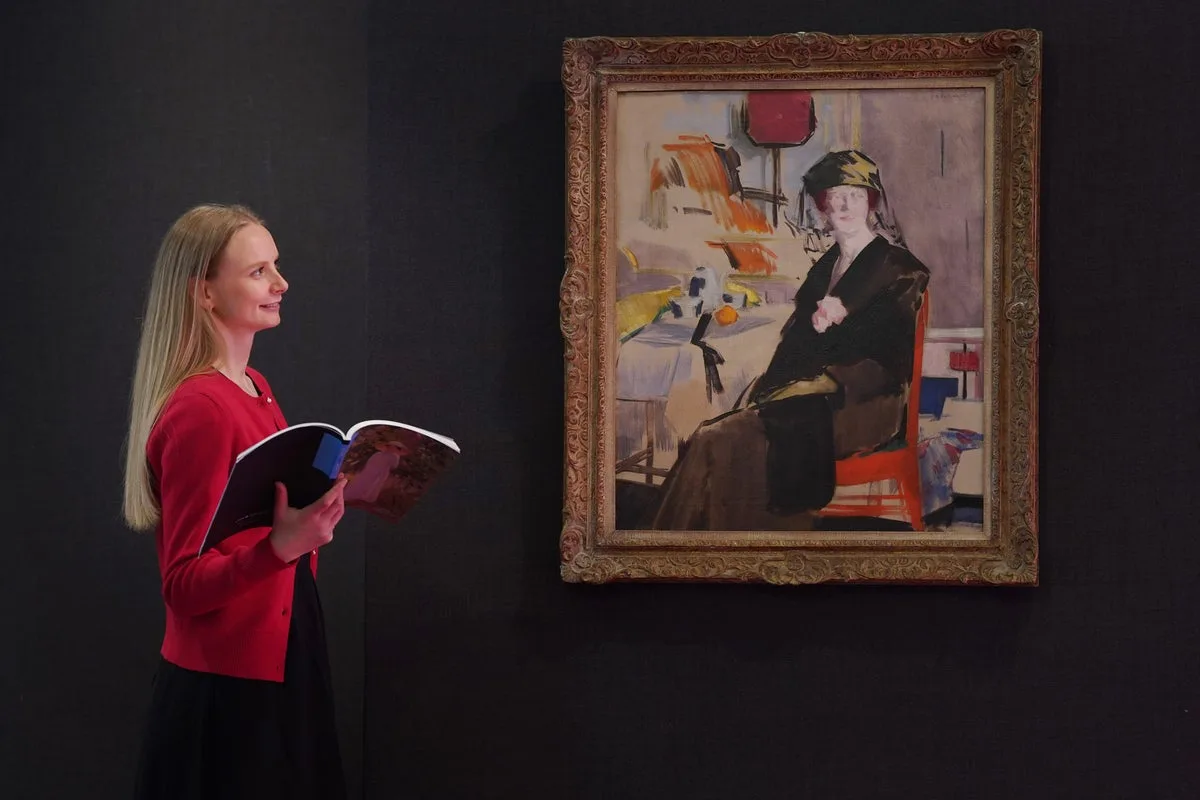
A painting purchased for less than 100 US dollars in a suburban New York charity shop during the 1960s could now achieve up to £200,000 at auction, following its identification as a work by the renowned Scottish Colourist Francis Campbell Boileau Cadell.
Art teacher and artist Helene Plotkin was captivated by the picture when she discovered it in a shop in White Plains in 1966 while searching for pieces to adorn her new home. The painting, titled Portrait Of Miss Don Wauchope, bore an illegible signature. Mrs Plotkin, then in her late 20s, acquired the piece for less than 100 dollars (approximately £75 in today's currency) and displayed it on her living room wall, oblivious to its true value.
The painting's background only came to light last year when her son Barry initiated his own research into the artwork. The signature in the upper right corner was deciphered with the assistance of AI technology, and specialists at auction house Lyon & Turnbull confirmed the artist as the celebrated Scottish Colourist.
Mr Plotkin expressed the family's astonishment at the revelation. He remarked: "We grew up with this on the wall. It was always there in the background. I remember playing American football in front of it with my brother, David, when we were young. It's amazing it survived our childhood. We were, as you can imagine, delighted and astounded when we found out the identity of the artist and of the model. For mum, it was confirmation of her artistic eye and ability to recognise great talent."
Cadell was one of the artists known as the Scottish Colourists, alongside SJ Peploe, JD Fergusson, and GL Hunter, who were active in the early 20th century. Born in Edinburgh in 1883, he trained in Paris and Munich.
Mrs Plotkin, now 88 and residing in Florida, recalled how the painting stood out to her when she first saw it in the charity shop. She said: "My background in art history and studio practice drew me to this piece instantly. The painting had an undeniable, regal presence, but it was the colour theory at play that held my attention. The way the pastels were integrated into the composition was both interesting and bold – it was clearly the work of a significant hand with a deep understanding of light and form. I was captivated by the sheer quality of this piece. Beyond the poise of the subject, the technical brilliance of the colour palette – specifically the interesting use of pastels to define the interior – spoke to me as an art student. It was a work that demanded to be appreciated for its vibrant, modern sensibility."
Lyon & Turnbull specialist Alice Strang identified the sitter in the painting as May Easter, rather than Bethia Hamilton Don Wauchope, and the title has been updated to Interior: The Lady In Black. The work will be auctioned in Lyon & Turnbull's Scottish paintings and sculpture sale in Edinburgh on Thursday June 4, with an estimated value between £150,000 and £200,000.
Experts date the work to the most significant and successful period of Cadell's career. He gained recognition with solo exhibitions in Edinburgh and London before the First World War and was demobilised from the army in 1919. The following year, he purchased 6 Ainslie Place in Edinburgh's Georgian New Town, opposite his childhood home at number 22. There he painted Interior: The Lady In Black, which depicts his north-facing studio on the first floor.
Ms Strang commented: "Cadell's stylishly decorated home became the subject matter of a remarkable series of works created in the 1920s. This painting is a magnificent bringing together of many of his most celebrated motifs."
Interior: The Lady In Black was previously sold by Christie's in London for £21 just months before it was discovered in the US by Mrs Plotkin. Ms Strang added: "How the painting ended up in a charity shop in New York so soon afterwards is a mystery, but we are, as you can imagine, thrilled that this terrific Scottish Colourist work has returned to the city in which it was painted some 100 years later. It shows why Cadell is one of Scotland’s most celebrated artists and why his work is so highly sought after for private collections and so admired in public collections."