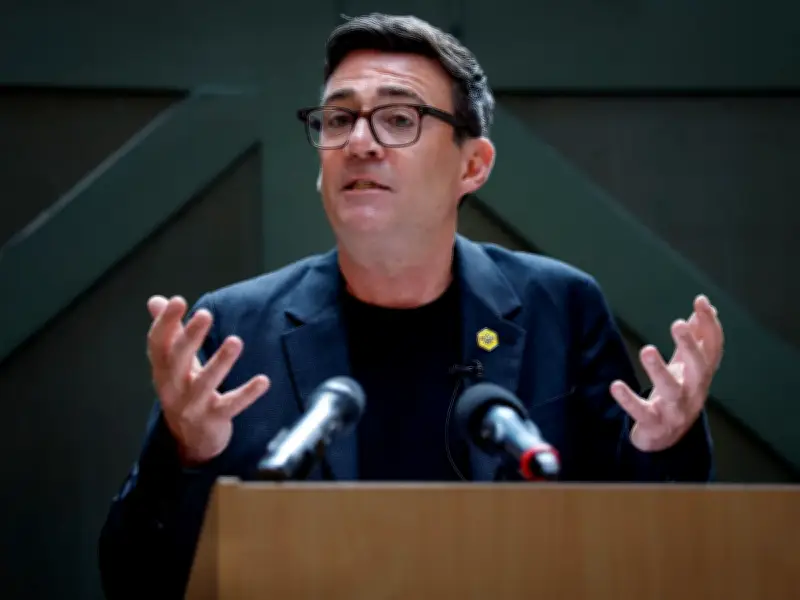
Andy Burnham concluded a major speech in Manchester to rapturous applause from Labour MPs, councillors, and mayors, evoking John Lennon's iconic song 'Imagine'. 'Imagine – good growth in every postcode and hope in every heart,' the Prime Minister-to-be told Manchester’s People’s History Museum, promising to 'rewire' the malfunctioning British state. 'Well imagine no more. Let’s make it happen.'
Burnham's Vision for a Rewired Britain
Potentially just three weeks before taking the keys to Downing Street, Burnham is asking the nation to believe in his plan to get the economy growing everywhere, bring down energy costs, and accomplish the biggest council house-building programme since the Second World War. The proposals would bring about the 'biggest rebalancing of power our country has seen,' he said, promising to overcome Whitehall’s resistance to change. 'Let me say this very directly: the days of Whitehall fighting the devolution of power into the regions and nations are over for good.'
His vision went down a storm in a room largely filled with Labour allies and supporters of moving power out of Westminster. To ensure nobody could bring the mood down, no questions were permitted from journalists. Burnham singled out BBC's Chris Mason with a pointed remark, brushing off 'wild speculation' about key appointments like Chancellor, with incumbent Rachel Reeves reportedly likely to be replaced.
Scrutiny and Regional Support
As metro mayor, the so-called 'King of the North' is regularly scrutinised by local voters and media, from weekly phone-ins to 'Ask Andy' events. But being Prime Minister is a job of an entirely different order, one that has proved too much for many incumbents over the last decade. Many are uneasy about Burnham entering Number 10 with no meaningful scrutiny of his policies by journalists.
North East mayor Kim McGuinness called the speech 'absolutely brilliant'. Burnham promised to hand over control of employment support to regions, meaning the North East can decide how best to help people into work. In a region with the country’s highest rate of economic inactivity, few will argue with such a move.
Manchester's Success and Wider Implications
The wider question is whether the success Burnham has seen in his decade as Greater Manchester mayor can percolate out to the rest of the country if Westminster loosens its grip. His region has a thriving economy and growing cultural clout, much of which, as Burnham admitted, was down to political leaders encouraging private investors before he arrived.
After successfully bringing buses under public control in Greater Manchester, Burnham will give regional leaders power to get 'greater public control of essential services' including water, energy, and transport. A Greater Manchester scheme to take 'social value' into account when handing out big government contracts will be replicated to ensure 'British-based companies are in a better position to win contracts'.
Number 10 North and the 'Place-First' Mindset
Perhaps most eye-catchingly, there will be a 'Number 10 North' in Burnham's Manchester stronghold, an operation that would be the 'nerve centre of a rewired Britain', redistributing power and resources. South Yorkshire mayor Oliver Coppard said he was surprised by how far Burnham went with the idea.
At the heart of Burnham's speech was the idea that the 'fragmented, disjointed' Westminster system hoards too much power. He wants the whole country to adopt the 'place-first' mindset of Greater Manchester, where political leaders pull together regardless of party. 'Problem-solving, not point-scoring. Long-term, not short-term. A decade on, it’s incredible how much we’ve been able to achieve by working together instead of fighting against one another.'
Challenges Ahead
That approach has worked in his region, which has been Labour-dominated with little local resistance. But is it realistic in Teesside, where Conservatives and Labour have been at odds for years? Or in the North East, where Labour mayor Kim McGuinness faces a cabinet of Reform UK leaders hostile to Labour policies? At national level, the country has never been more divided. As Burnham admits, bringing the country together to recreate 'Manchesterism' at a wider scale 'is not as easy as it sounds', requiring 'radical change'.
With Reform UK leading in the polls and a General Election three years away, Burnham may not have the time or political clout to overcome the huge obstacles to rewiring the country.