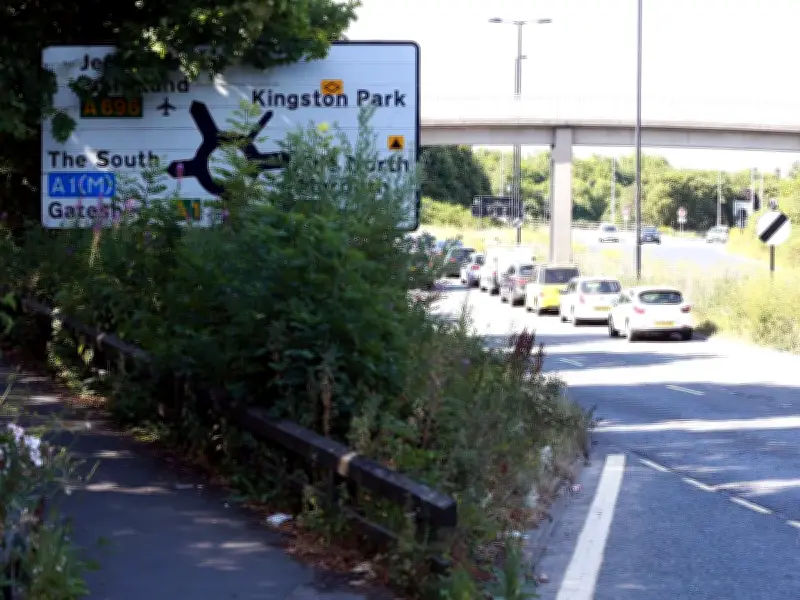
UK households are being urged to prune and trim any overgrown plants, branches, and hedges on the perimeter of their garden or risk a hefty fine from their local council.
The warning follows a report from the RAC which revealed that one-in-five (19%) drivers have accidentally broken the speed limit after not being able to see a road sign obscured by foliage. Almost all drivers (94%) polled by the motoring group said they've seen road signs covered by overhanging branches, trees or hedges, and half (51%) said they frequently see signs in this state.
Obscured signs and junction dangers
The most common signs obscured by overgrown foliage include speed limit signs, stop signs, and give way signs. As a result, 21% have missed a turn, 13% have had to brake sharply, and 5% have accidentally ignored a give way sign.

It isn't just road signs being taken over by shrubs. Some junctions have also been affected, with four-in-five drivers (80%) reporting that overgrown foliage has made it difficult to safely pull out of a junction or roundabout.
Not only can obscured road signs have serious road safety implications, the issue could also land homeowners with a bill from the council. This is something more than half (58%) of the people surveyed weren't aware of.
Legal rules under the Highways Act 1980
Under Section 154 of the Highways Act 1980, if vegetation on your property overhangs a public road or pavement, or blocks visibility of road signs, junctions or streetlights, you are legally obligated to cut it back. The local highway authority may serve a notice upon the landowner to remove the vegetation within 14 days.
Failure to do so can result in the local authority performing the necessary works and recovering the costs from the landowner. Legal responsibility lies with the landowner or the occupier of the land from which the vegetation is growing.
The local authority can serve a Section 154 Notice for the occupier to remove the overhanging vegetation within 14 days, perform the necessary works and recover reasonable costs from the landowner if they fail to comply, and prosecute under Section 137 of the Highways Act for wilfully obstructing a highway (penalty of up to 51 weeks imprisonment or a level 3 fine capped at £1000 per offence).
Reporting and appeals
Anyone can report a blockage via the Gov.uk tool to report obstructions on the road, an online reporting tool for motorways to contact National Highways, local authority online reporting tools, or alternative websites and apps such as FixMyStreet.
It is possible to appeal a Section 154 Notice through your local Magistrates Court within 14 days of having received the notice. Landowners are at liberty to report their obstructions to the council prior to receiving a Section 154 Notice, though costs may still be applicable. During the appeal, the homeowner can explain why they believe the notice is incorrect, and the court will decide whether to uphold, amend, or cancel the notice. Until the court makes a decision, the notice is usually paused, meaning the council should not take enforcement action during that period.
RAC spokesperson Harriet Hernando said: "It's concerning that so many drivers have broken the speed limit because they haven't been able to see a road sign that has been obscured by foliage. And while a small number have accidentally ignored a give way sign, the effects of doing so can be catastrophic."
She continued: "As many welcome rain to give their gardens a much-needed boost after such a dry summer, it's worth checking whether any plants, branches or hedges growing on your property spill onto a public road or pavement. Cutting them back to ensure signs are clearly visible, and pavements are free from any obstacles, goes a long way in ensuring the roads are safe for all."
RAC advice to avoid fines
The RAC advises checking your boundaries regularly, keeping sightlines clear, trimming back to the boundary, avoiding trimming during rain or storms, considering accessibility needs, acting quickly if you receive a warning, keeping bins tucked away, and reporting issues early if you can't manage the work.
If you're unable to cut back vegetation yourself, contact the council before a notice is issued. Costs may still apply, but doing so will help you to avoid escalation or penalties.