A Chinese rescue team has reached the all-but-obliterated Gyirong border crossing complex for the first time and found "nothing but ruins" as Nepal and China continue their arduous rescue operations in the flood-hit Himalayas.
Surveillance camera footage from the worst-hit Gyirong border crossing complex showed huge torrents of water and debris on Wednesday engulfing buildings and people trying to flee. Only on Friday were rescuers able to reach that area.
Rescuers navigate treacherous terrain
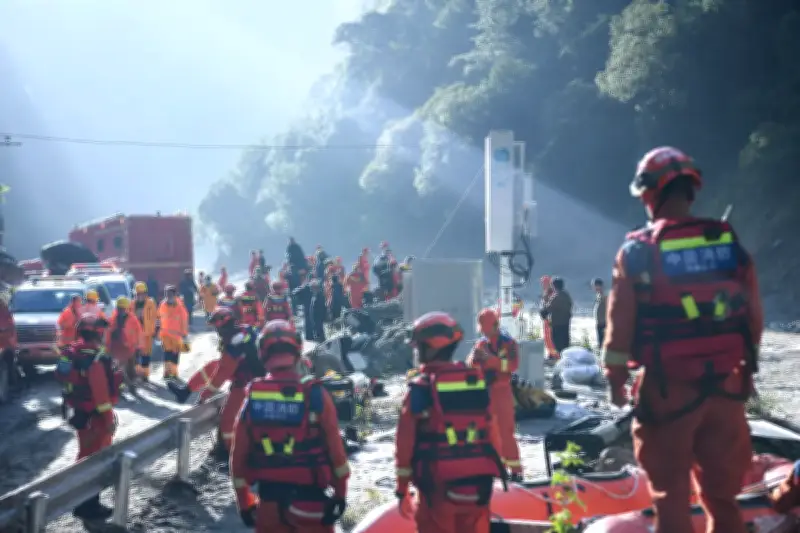
State media reported that the Chinese team of 21 rescuers and a search-and-rescue dog crossed mountains and valleys and used ropes to navigate forests and cliffs after roads to the complex, hemmed in by steep Himalayan slopes, were destroyed.

"There was no road … it was all virgin forest and sheer cliffs," rescue worker Zou Mingqi said. At the complex, "as far as the eye could see, there was nothing but ruins."
Death toll and missing numbers
The glacier collapse which unleashed a huge torrent of rock, ice, mud and debris through Himalayan mountain river systems has killed at least 579 people in Nepal and seven in China's Tibet. The number of missing in Nepal has nearly doubled to 1,924, officials said on Friday. At least 558 were missing in Tibet's Gyirong County, Chinese state broadcaster CCTV has said. Among the missing are at least 540 foreigners, many of them Hindu pilgrims from India.
More than 90,000 people are estimated to have been affected by the disaster, the Red Cross said.
Nepal requests foreign technical aid
Nepal has said it needs foreign help in specialised and technical areas in which it does not have expertise, but not in search and rescue. Those areas include opening transport and communication services in places where bridges have been destroyed, identification of dead bodies, DNA testing and storing bodies for longer durations, the country's foreign minister, Shisir Khanal, said late on Friday.
India and China, between whom Nepal is wedged, have been requested to supply bailey bridges to reopen transport and communication in an area where about two dozen bridges had been destroyed.
Earlier on Friday, Nepal's foreign ministry had said that Kathmandu could manage the rescue efforts on its own for now and declined foreign involvement. Asked about that stance of his government, Khanal said there was no need for assistance in general search and rescue which was being done by Nepali rescuers. "We think there is no need for repetition in this," he said.
Ongoing monitoring and risks
Nepal is continuing to monitor two barrier lakes upstream of the flood zone, with an official warning that flood risks will persist until both lakes fully drain. Satellite imagery showed the second lake growing larger with no visible outlet, raising concerns that water pressure could still be building.
China's state-run Xinhua news agency said that the first barrier lake was reducing in size, citing analysis by the water resources ministry. A Chinese government geo-hazards expert warned, however, that the lake may be unstable and that over 100 glacial lakes scattered throughout the area could pose a threat.
In Beijing, a politburo meeting chaired by President Xi Jinping called for stronger monitoring of glacier lakes and landslide risks, and for closer international disaster cooperation, Xinhua reported. China's Premier Li Qiang, the country's No. 2 official, arrived in the area of Gyirong on Thursday afternoon, Xinhua said. The visit suggested Beijing was treating the disaster as a matter of the highest national priority.
In China, strict controls on the flow of information from one of its most sensitive regions are hampering the public's understanding of events. The BBC and NY Times have reported videos of the catastrophic floods, widely shared globally, have not appeared on Chinese social media sites.
Chinese state media has carried several broadcasts about the floods and dispatched their own journalists to the area, but reports have focused on the rescue efforts rather than the scale of the devastation. In one broadcast from a relief centre in Tibet, the journalist did not speak to any of the people sitting behind him.

Tibet, brought under Chinese control in the 1950s, is the most sensitive and tightly controlled region in the country. The Gyirong border port plays a key role in China's Belt and Road network linking the country to South Asia, with logistics zones and parking lots built there in the past decade.