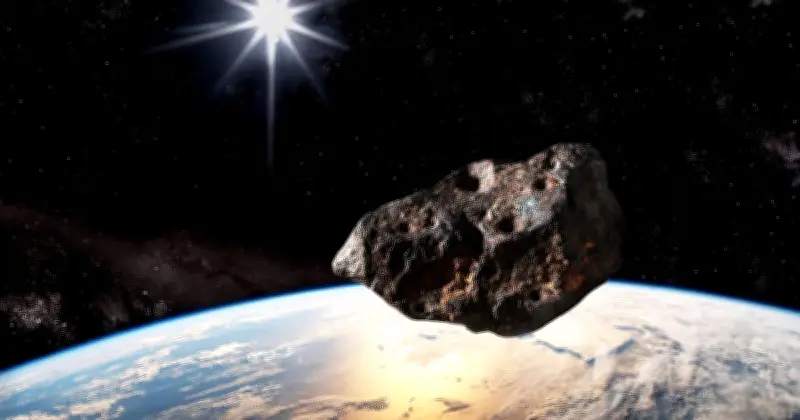
A 2019 NASA simulation, named Chodas, imagined an asteroid fragment striking New York in 2027 after a deflection attempt broke the space rock apart, leading to humanity's extinction.
Simulation details
The scenario began on the opening day of the conference with a massive asteroid, designated 2019 PDC, measuring between 330 and 1,000 feet, racing towards Earth. Initially, the simulation suggested the asteroid had just a one per cent probability of striking Earth, before a fictitious press statement was released, according to the Centre for Near Earth Object Studies (CNEOS).
The statement said: "College Park, Maryland, USA, April 29, 2019. The International Asteroid Warning Network has announced that a recently discovered near-Earth asteroid could pass very close to the Earth 8 years from now, on April 29, 2027, and there is a small chance – 1 in 100 – that it could impact our planet."
Impact and aftermath
Scientists were unable to stop the catastrophe. The asteroid entered Earth's atmosphere at 43,000mph before hitting New York with an explosion 1,000 times stronger than the nuclear bomb dropped on Hiroshima, Japan.
The dramatic simulation was developed by the space agency for the Planetary Defence Conference Exercise 2019, staged during the International Academy of Astronautics Planetary Defence Conference (PDC) between April 29 and May 3, 2019, in Washington, D.C. The yearly gathering assembles asteroid specialists from NASA, the European Space Agency (ESA) and additional organisations to devise strategies for protecting our planet should the worst scenario unfold.
Deflection attempts
The second day of the conference looked at the year 2021, when in the simulation NASA had dispatched a probe to examine the asteroid in greater detail. At this stage in the exercise, the space rock was heading towards Earth, with the impact location narrowed down to Denver, Colorado.
By the third day, every nation's space agency opted to construct a fleet of six "kinetic impactors," spacecraft engineered to collide with the asteroid, reducing its velocity and potentially redirecting it away from Earth. These craft were deployed in 2024, three years before impact, with three successfully striking the planet-threatening asteroid. Yet while the asteroid fractured, it was not broken, meaning a smaller fragment would still strike America's east coast.
Evacuation as last resort
As with the 2027 anticipated devastation of New York City, the sole remaining option is large-scale evacuation. Approximately 20,000 near-Earth asteroids have been identified to date, with around 150 additional discoveries made each month, according to the CNEOS.
NASA and the Federal Emergency Management Agency (FEMA) published an 18-page report in 2018 outlining the measures both organisations would implement over the following decade to avert genuine asteroid impact threats and prepare for a possible catastrophic event. The stark reality is that large-scale evacuation frequently remains the sole viable option.