
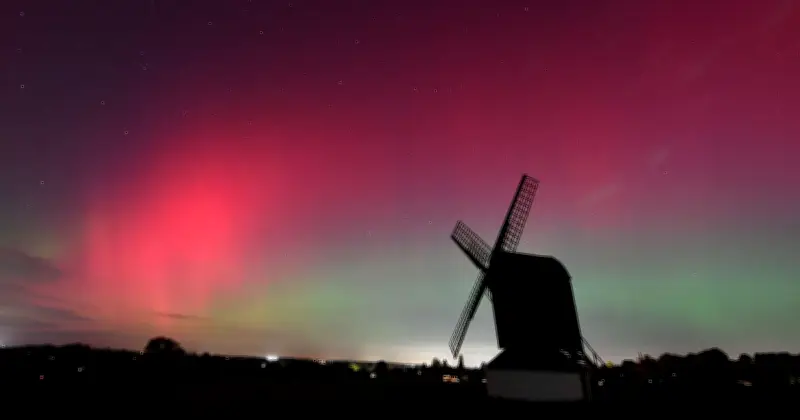
The Met Office has said the Northern Lights could be visible in parts of the UK on Monday night, with the phenomenon potentially appearing further south than on Sunday.
What causes the Northern Lights
Known as the Aurora Borealis, the lights are triggered by solar activity, with the sun emitting charged particles known as solar wind. When these particles interact with the Earth's magnetic field, they are funnelled towards the magnetic poles, and when they collide with gases in the upper atmosphere, they release energy as light.
Oxygen produces green and, at higher altitudes, red, while nitrogen creates blue and purple hues, the weather forecaster said. The lights are most visible around the equinoxes in spring and autumn.
Weekend sightings across the UK
Over the weekend, stargazers across large swathes of the UK were able to see the aurora as it lit up skies over the ruins of Dunstanburgh Castle on the Northumberland coast in the early hours of Sunday. Pictures also captured the green and pink spectacle as far south as Kent and Surrey.
In an update on Sunday, the Met Office said the Northern Lights could be visible in the UK on Sunday and Monday night.
Forecast for Monday night
"They could be a little weaker tonight (Sunday), so most likely seen across Scotland, Northern Ireland and northern England," said forecaster Greg Dewhurst. "They may be a little stronger again on Monday night so could be seen further south into central areas."
Unlike with eclipses, it is safe to view the phenomenon with the naked eye without risking damage to your eyes. However, it can sometimes be better seen through a camera.
"Long exposure camera shots may show something each night a little further south than the above visible by eye forecast," Mr Dewhurst explained. The Met Office previously said sightings could be possible during clear skies until Tuesday, October 13.
How to track the aurora
Regular updates about the chances of the Northern Lights being visible are available on Aurorawatch UK, a website run by scientists at Lancaster University.
An FAQ on its website explains that various factors affect when the aurora may be visible, and that the site "measures the effects of those interactions on the Earth's magnetic field from the UK" and issues alerts when an aurora may be visible, but not predictions ahead of time. It notes that visibility is impacted by "things like daylight, cloud cover, and light pollution may impact on whether you will actually be able to see the aurora".
It adds that "statistically, the best time to see an aurora is between 10pm and midnight (though sometimes the aurora can be seen throughout the night)" when the processes behind the phenomena generally peak.




