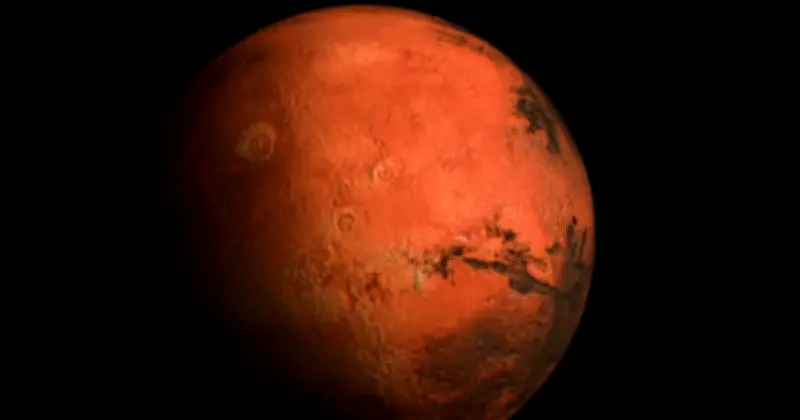
A self-styled "Living Nostradamus" has identified six regions on Earth where humans can find the key to surviving on Mars. Athos Salomé told the Daily Express that these locations replicate the inhospitable conditions found on the red planet.
Putting humans on Mars poses enormous challenges, including solar radiation, changes in gravity and the time astronauts would spend in space. Once there, astronauts would rely on technology to breathe, withstand freezing temperatures, eat, drink and work, while also facing Martian dust storms and cosmic radiation.
Earth as a vast laboratory
Salomé said: "Earth serves as a vast laboratory where humanity can prepare for existence on other planets. NASA clearly states that these types of environments enable scientists to test equipment and procedures for future missions without needing to travel off-planet."

He added: "While this does not prove that a potential 'trip to Mars' is actually happening right now on Earth, it does raise an intriguing question: If we can currently transform remote sections of Earth into experimental versions of Mars, what limits might exist for such simulations in the future?"
Six Mars analogues on Earth
The first location is Chile's Atacama Desert, widely recognised as the driest place on the planet. Salomé said: "It is used to research very dry soils, possible bio-signatures, and conditions that exist on Mars."
Devon Island in Canada is another spot, known for its cold weather, remote location, rocky terrain and the Haughton Crater. The crater lends its name to the Haughton Mars Project, a field research facility testing new technologies and operational procedures for future missions.
McMurdo Dry Valleys in Antarctica, one of the coldest and driest places on Earth, has been used for decades as a Martian parallel. It has not seen rain for millions of years.
Mauna Loa in Hawaii is a fourth location, due to its volcanic terrain, minimal vegetation and isolated location. It is home to HI-SEAS, the Hawaii Space Exploration Analog and Simulation, a research station simulating life on Mars or the moon.
Iceland is the fifth location, used for its volcanic landscapes and barren terrain similar to Mars and the Moon. Salomé noted that Artemis astronauts have carried out geological training there.
The final location is the Mojave Desert in the United States, whose arid climates and wind-formed features are used for comparisons with Mars.
No single perfect replica
Salomé said: "Would it be a fatal error to attempt to live on Mars without having conquered these environments first? No, but it would certainly be a huge mistake to disregard the importance of this type of training."
He concluded: "The bottom line is that no single location on Earth can completely replicate Mars. Mars has an extremely thin atmosphere, a weaker gravitational pull, different radiation levels, extreme temperature fluctuations and no naturally breathable environment. Due to this fact, researchers utilise natural analogues in conjunction with controlled habitats and simulations."