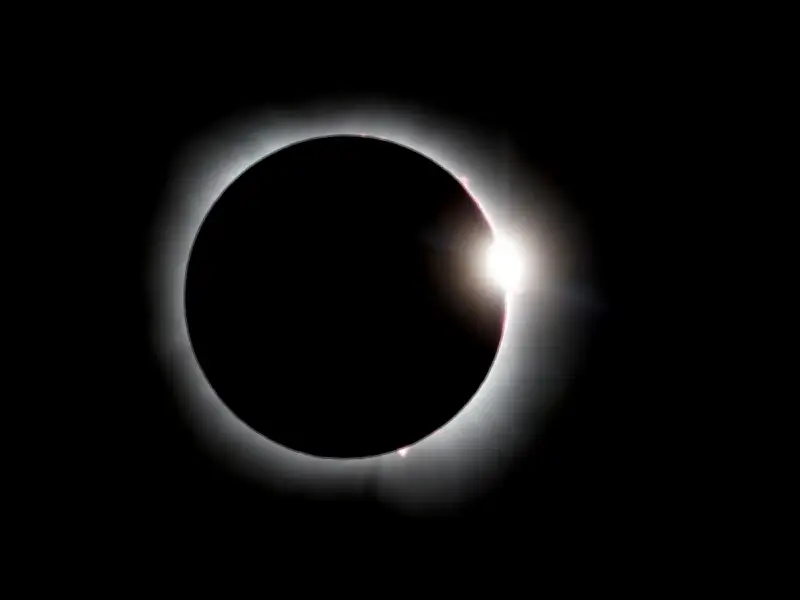
A rare solar eclipse will be visible across the UK on the evening of August 12, when the Moon passes between the Earth and the Sun, obscuring around 90% of the Sun's light from large parts of the country. It will be the deepest solar eclipse visible from the UK since the famous 1999 event.
Eclipse details and visibility
In Greater Manchester, sky watchers will see the Moon cover around 91% of the Sun's light, while in parts of Ireland, including Dublin, the Moon could obscure 94%. From parts of Europe, including the Balearic Islands in Spain, a total eclipse will be visible, with 100% of the Sun's light blocked.
Experts at the Royal Museum of Greenwich said that 'first contact' will occur at 6.17pm on Wednesday, August 12, when the Moon first covers part of the Sun's disk. The eclipse's maximum will be at 7.12pm from London, when roughly 90% of the Sun is covered.
A spokesperson said: "The Moon will move slowly in front of the Sun until roughly 90 per cent of the Sun is covered (the eclipse's maximum). This will be at 7.12pm from London."
They added: "At the maximum, enough of the Sun will be covered to make a noticeable difference in the temperature and light levels. However, unlike with a total eclipse, the sky will not become dark – it will feel more like a cloudy day or close to dusk or dawn."
Eye safety warnings
During an eclipse, the Sun appears dimmer than usual, making it easier to look at directly. The reduced brightness can override the body's natural reflex to look away, allowing intense sunlight to reach and damage the retina. This damage can happen without causing pain, so you may not realise harm is occurring until it's too late.
After the 1999 total solar eclipse, the Royal College of Ophthalmologists reported around 70 cases of people experiencing vision problems after watching the eclipse, the UKHSA warned.
There are two safe approaches to viewing the eclipse: specialist eclipse viewers or indirect viewing methods. If using eclipse glasses or handheld solar viewers, ensure they are genuine with specially designed filters that meet the international safety standard. The UKHSA warns to be cautious of products sold online as they may not meet the requirement.
How to make your own pinhole viewer
You can watch the eclipse indirectly without any specialist equipment by making a pinhole viewer. Here's what you need: two pieces of stiff card or paper plates (A4 works), a small piece of aluminium foil, tape, a pin or needle, and scissors (optional).
Step one: Take one piece of card and cut a small square hole around two or three centimetres wide in the middle. Tape a piece of foil over that hole so it's flat.
Step two: Use a pin or needle to make one small, clean hole in the centre of the foil. Don't make it too big as the image will appear sharper with a smaller hole.
Step three: The second piece of card should be plain white. If it's not, glue some white paper on it – this is your screen to watch the eclipse on.
Step four: When the eclipse is taking place, stand with your back to the Sun. Hold the pinhole panel up so sunlight passes through the pinhole onto the other card. Adjust the distance between the cards – around 30cm to one metre tends to work best – until the projected image is clear. You should see a small circle of sunlight on the screen, which during a solar eclipse becomes a crescent.