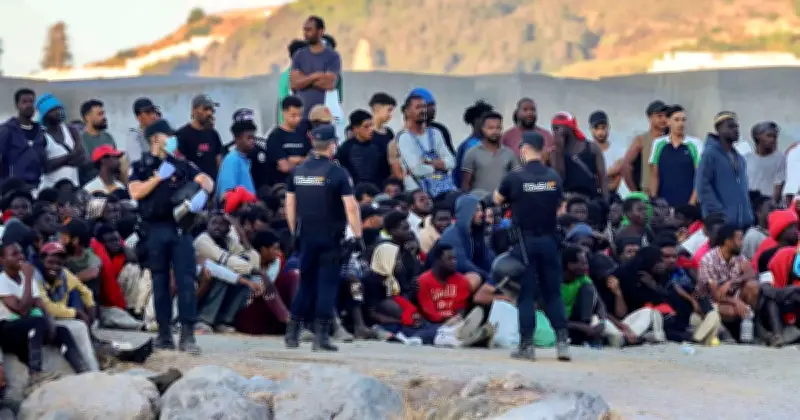
Between 3,000 and 5,000 migrants are still in the Spanish territory of Ceuta almost a week after a mass crossing from Morocco, with the enclave's leader warning some are "basically impossible" to return.
Juan Jesús Vivas said that despite nearly 75,000 people having already been returned to Morocco following last week's unprecedented influx, thousands remain in the north African territory.
Mass crossing and tragedy
Addressing the European Parliament on Thursday, Mr Vivas spoke of his "profound sorrow" over the "irreparable tragedy" that claimed around 100 lives after roughly 78,000 migrants arrived by sea in a matter of hours.
His comments came as Moroccan media reported fresh calls circulating on social media and WhatsApp groups encouraging another mass attempt to reach the Spanish enclave.
Criticism of response
Mr Vivas criticised the Spanish Government's response to the crisis, saying he had personally warned Prime Minister Pedro Sánchez that it had come too late and was insufficient.
"The fact that we don't have numbers on how many are still in Ceuta shows how few resources we have to deal with this situation," he said, adding that previous warnings from local officials about an increase in sea crossings had been ignored.
Humanitarian emergency
While the return of nearly 75,000 migrants to Morocco had "considerably alleviated" the situation, Mr Vivas said Ceuta had still not returned to normal. He said the territory continued to face a humanitarian emergency and public order disturbances, adding it was "basically impossible" to return the migrant minors who had crossed because doing so, he said, required their consent.
Spain's Interior Minister has announced €25million (£21.4million) in funding to support migrant children in Ceuta. However, Spanish newspaper El Mundo reported that volunteer groups had registered 4,860 migrant children in the territory – around double the official estimate.
One volunteer told the newspaper: "Neighbours are taking them into their homes, but the situation is unsustainable."
EU tensions and support
The European Commission has praised Spain's "swift response" to the crisis, which included deploying armed forces to Ceuta and Spain's other north African territory, Melilla.
However, the influx has also heightened tensions within the European Union. Italy has suspended its Schengen arrangement with Spain, with Finland and Denmark backing the move, while the Czech Republic has called for Spain's membership of the border-free area to be temporarily suspended.
EU Migration Commissioner Magnus Brunner said criminal networks spreading disinformation may have encouraged the mass crossings, a view also supported by Mr Sánchez. Mr Brunner said the EU was prepared to do more to help Ceuta but had not received a further request from Spain for additional border guards. He also said the bloc should use "all the leverage at its disposal", including visa policy and trade, to secure Morocco's co-operation on migration.
Morocco's stance
Morocco, meanwhile, has blamed Spain's Supreme Court, arguing a recent ruling preventing migrants intercepted at sea while attempting to reach Ceuta or Melilla from being summarily returned weakened the deterrent effect and contributed to the surge.
Ceuta and Melilla have long been a source of diplomatic tension between Spain and Morocco, which does not recognise Spanish sovereignty over either territory.