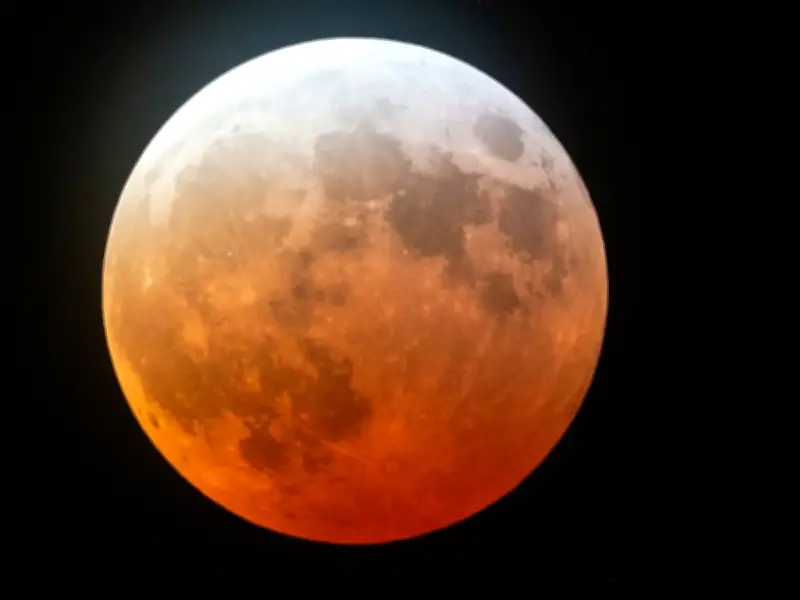
A deep partial lunar eclipse turned the Moon a striking red across the UK and Ireland in the early hours of Friday, with around 93% of the lunar surface moving into Earth's darkest shadow at its peak.
The phenomenon occurs when Earth positions itself directly between the Sun and the Moon, casting its shadow across the lunar surface. At maximum eclipse, around 93% of the Moon was within the umbra, the darkest part of Earth's shadow, at approximately 5.12am.
The event was enhanced by the "Moon Illusion," where the Moon's low position on the horizon made it appear larger than normal. Cloudy conditions hindered viewing in some parts of the UK, but several areas, including Oxfordshire, managed to capture the spectacle.

Key timings and visibility
The eclipse began at 2.23am, when the Moon started entering the lighter outer part of Earth's shadow, known as the penumbra. By 3.33am, part of its surface moved into the darker umbra, marking the start of the partial phase. The maximum was reached at 5.12am, with around 93% of the Moon inside the deepest shadow.
In London, moonset was expected at around 6.15am, meaning viewers in the UK and Ireland would not see the eclipse through to its conclusion, with the partial phase ending at 6.51am. The Met Office had forecast that southern and eastern England were likely to have the greatest chance of seeing the earlier stages, with cloud becoming more widespread as the night progressed.
Global views and safety
The eclipse was visible across several continents, including North and South America, Africa, and parts of Europe, with some countries witnessing it on the evening of August 27 and others in the early hours of August 28 due to time zone differences. Images captured the event from locations including Athens, Rome, Panama City, and Bogota.
Unlike a solar eclipse, no protective glasses were needed to watch the lunar eclipse, as it is safe to look directly at the Moon with the naked eye throughout the event. The reddish or copper colour, leading to the nickname "blood moon," results from sunlight passing through Earth's atmosphere.