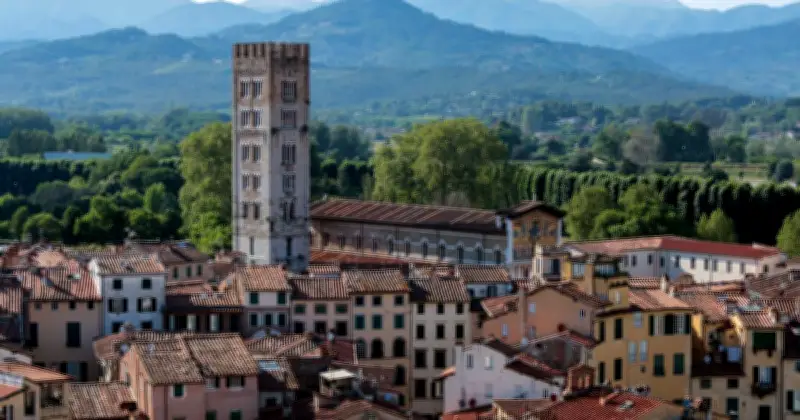
After visiting 14 Italian cities, Deputy Travel Editor Milo Boyd has singled out Lucca as the one he keeps returning to, describing it as offering everything needed from an Italian destination.
His first family holiday abroad was at the end of primary school, when three families drove for two days to a villa in Tuscany, a region sometimes called Chiantishire because of its British visitors and wine production. During that trip, the family explored Florence and Pisa, but none of those places held a candle to Lucca, which he has since visited three more times.
Compact city with dense history
Lucca is smaller and less famous than Florence and Siena to its east, and attracts fewer transiting tourists than Pisa to its west. The charming city of 90,000 people is, in Boyd's view, the perfect place to visit for a day or two.
The Romans arrived in 180 BC, and their influence is still evident in the rectangular street layout, even though the grand amphitheatre they built is now ruined. More prominent are the city's many Gothic churches, over 100 by one count, and 16th-century palaces such as the Palazzo Pretorio and the Palazzo della Prefettura, which houses the National Art Gallery.
Walls, piazzas and music
The city is best understood from the top of its 4.2 km of walls, built between 1504 and 1648 to defend against Florence and Pisa. The walls were never needed in battle; the most action they saw was holding back a major flood of the Serchio River in 1812. Today they are a tree-lined public promenade and park, shaded by roughly 1,000 mature plane and horse chestnut trees.
Piazza dell'Anfiteatro is the prettiest spot in Lucca, with yellow-painted, green-shuttered buildings surrounding the ovular piazza, which opens up at four gateways. While much smaller than Siena's scallop-shaped piazza, Boyd finds it prettier and more manageable of an evening, with restaurants bringing tables out onto the slabs and offering more personal service than in busier Tuscan cities.
Lucca also boasts a long musical tradition. It is the birthplace of opera composer Giacomo Puccini and a number of world-class musicians, including Nicolao Dorati, Giovanni Lorenzo Gregori, Francesco Barsanti, Francesco Geminiani, Filippo Manfredi and Luigi Boccherini. Puccini's home is now a small museum, set up as it would have been when he lived there, with his actual piano, personal letters, costumes and opera memorabilia.
Boyd concludes that while Italy is blessed with more beautiful villages, towns and cities than probably any country on Earth, those looking for a new one to visit will not go far wrong with Lucca.