At midnight in June, powder pink and dark grey clouds drift across a pallid sky, reflecting in the motionless water of Lake Inari. Islets of pine and budding birch create pools of distorted shade near the horizon of this vast lake in Lapland, northern Finland. Silence reigns so profound that the observer barely breathes. Only the lake and a moonbeam-coloured moth exist in this moment.
Beside a car-sized campervan, the writer sits with mesmerised reverence for the rose-tinged panorama. The wild freedom of being entirely alone, with no one knowing her exact whereabouts, is delicious. Ordinarily, midnight would find her asleep after work and family life. But she has left her husband and adult children in England for an eight-week solo camping adventure through Denmark, Sweden, Finland, and Norway, aiming to reach Nordkapp and Knivskjellodden, Europe's northernmost point, by midsummer.
Earlier, she met Father Christmas at Santa Claus's Main Post Office in Rovaniemi, the capital of Finnish Lapland. The costumed gentleman warned about reindeer: "We have 230,000 reindeer in Finland, but only one has a red nose." Indeed, countless reindeer appear in Finland, Norway, and Sweden, creeping through forests and grazing at the coast.
This encounter and the night beside Lake Inari are among many memorable experiences on the road trip through the Land of the Midnight Sun, where north of the Arctic Circle the sun does not set during summer. The adventure began in Denmark, after driving the campervan from the UK via Germany, starting in Rødby on the island of Lolland.
Other than reaching Nordkapp, there is no plan and no accommodation booked. The writer utilises Allemansretten (everybody's right), legal in Norway, Finland, and Sweden: the right to stop off-grid overnight on uncultivated land, leaving no trace. She parks overlooking fjords, beside mountain passes, and with lake or coastal views.
From Lolland, the route heads north to Helsingør for the ferry across the Øresund to Helsingborg, Sweden, leaving a rear-view image of Kronborg Slot (Hamlet's Castle) at dawn. Luminous lupins and puce pinks line the roadsides on the 370-mile cross-country route to Sigtuna, 30 miles north-west of Stockholm. This lakeside settlement of colourful timber houses is Sweden's oldest town. Half an hour north lies Linnaeus's Hammarby, an 18th-century farm once belonging to Carl Linnaeus, the botanist who developed the binomial naming system.
Hammarby represents the Uppland region well. The writer walks 10 miles along the Dannmark Trail between Linnaeus's farm and Uppsala, a route he walked with biology students. Students at Uppsala University celebrate finals, mingling around ice-cream cafes and in floral parks. The city's rust-red cathedral spires protrude above blossoming rowan trees.
From Uppsala, the E4 road reaches the Finnish border, covering over 600 miles in six days. Along the way, the writer crosses Scandinavia's longest suspension bridge, the Högakustenbron, at the Höga Kusten (High Coast), a UNESCO World Heritage site. Vast stretches of empty road lined with pine trees offer contemplation. But it is not until arriving in Karasjok, having crossed from Finland into Norway, that the scale of the Nordics becomes clear. Karasjok feels very far north, yet it is still a four-hour drive to Nordkapp.
Karasjok is the Norwegian administrative centre for the indigenous Sámi population of Sápmi, a cross-border cultural region including parts of Norway, Sweden, Finland, and Russia. The parliament building resembles a traditional lavvu tent, and nearby Sápmi Park introduces Sámi traditions.
Leaving Karasjok, the road winds alongside Porsangerfjorden, passing fishing hamlets, waterfalls, shaly mountain cliffs, and tremendous viewpoints before dipping beneath the Arctic Ocean by tunnel to reach Magerøya, the island where Nordkapp sits. Fine weather accompanies the climb beyond Honningsvåg, one of Norway's northernmost towns, over snowy mountain plateaux to Nordkapp. A tear forms as the writer stands alone, about 2,500 miles from home by the quickest route, wishing her family could see this. But this is a solo adventure, and she has reached her goal, staying up all night to watch the midnight sun send orange beams across the Arctic Ocean.
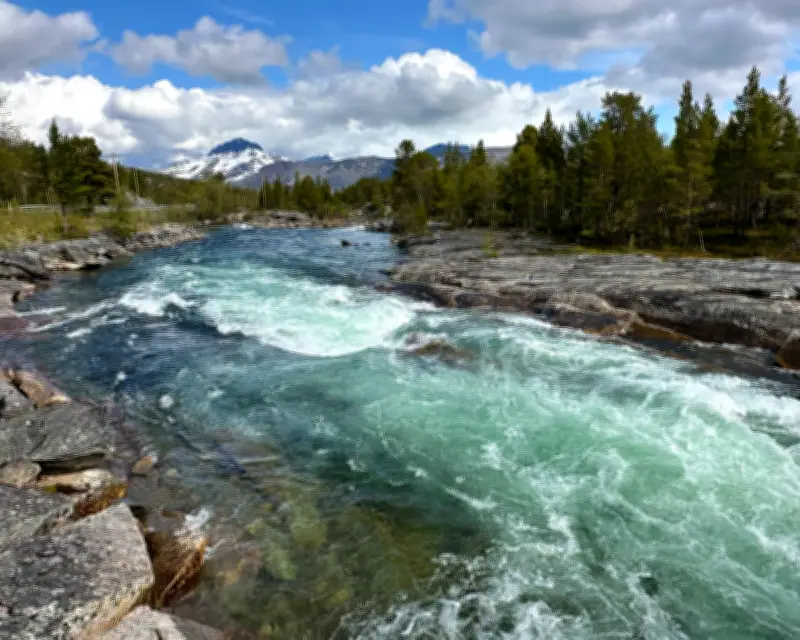
The return journey south through Norway, Sweden, and Denmark is contorted, meandering west and east. Picnics beside turquoise sea coves on the Lofoten Islands, watching pods of dolphins in the Norwegian Sea. Bulging rivers and thundering waterfalls in Saltfjellet National Park. Small farms and meadows with emerald stripes of hay, buttercups, and long lakes through Trøndelag. Norway bursts into colour after the bleached landscapes of the north. Some days involve 200-mile stretches; others are spent enjoying the view or taking long walks.
Atlanterhavsvegen, a 22-mile national scenic route across skerries connected by bridges, is captivating. Then Runde, one of Norway's westernmost islands, renowned for a puffin colony breeding on the cliffs. A steep mountain walk reveals people perching on cliff edges, hoping to witness birds coming in to roost. But it is the east of the island where the writer parks alone for days, watching an otter swimming among lichen-speckled black rocks, alerted by ducks and ducklings, shelducks, wigeon, and oystercatchers. Parent gulls shelter fluffed-up chicks as curlews call overhead. Orchids, sea campion, clover, and other flowers smother the coastal ground.
Another memorable experience is the wild camp at the summit of Sognefjellet mountain pass, the highest road in Scandinavia. Setting out from Lom, a town between three national parks with a famous stave church and the Norwegian Mountain Centre, the road runs alongside the Bovra River initially, then climbs into wild scenery. The overnight is cold, with huge frozen lakes of glacial blue and roadside snow above the campervan's height. In the morning, as Nordic skiers and snowmobiles head to nearby glaciers, the writer brushes snowflakes from the windscreen to descend to the green Sognefjord, as if stepping through a wardrobe from a wintry summer scene.
The writer appreciates that being alone by choice differs from loneliness. Often asked if she gets lonely, she explains she can feel lonelier in a crowded room than camping in the wild. Leaving family creates a sense of "wish you were here," but the adventure is understanding that the memory is hers alone—the thrill, excitement, calm, and occasional trepidation. She would do it all again tomorrow.
The writer travelled in her own campervan, using Scandlines ferries between Puttgarden, Germany, and Rødby, Denmark. In the UK and Europe, hire of Roadsurfer's smaller vehicles starts at £49 a night.