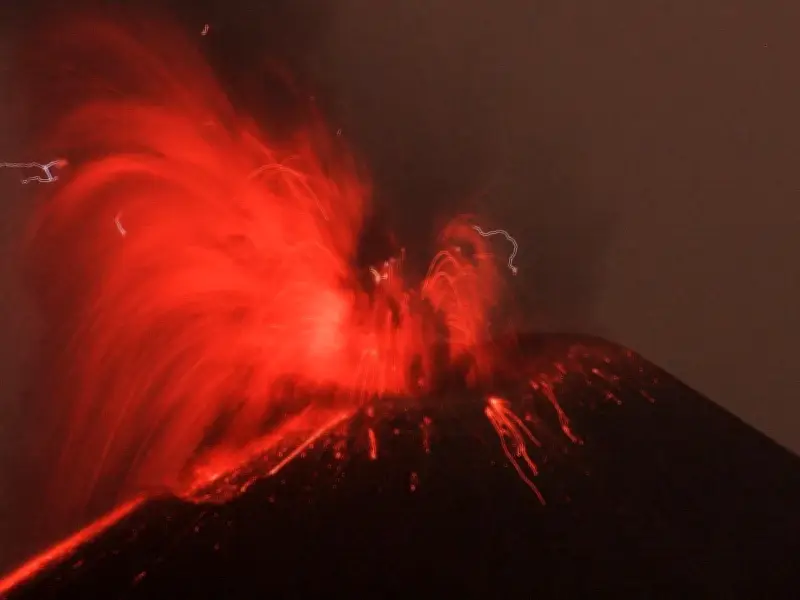
Tens of thousands of passengers have been left stranded after 209 flights were suspended when ash from the Anak Krakatau volcano blew into airspace near Jakarta's Soekarno-Hatta International Airport on Sunday. The airport, Indonesia's main hub, was closed because of the ash cloud, hitting major international routes and affecting more than 22,000 people.
Eruptions and ash fallout
The volcano began erupting on Friday night, with two further eruptions on Sunday. Local newspaper Kompas reported that schools cancelled activities on Saturday after students complained of eye irritation, and fishing vessels have been grounded over health concerns.
Resident Aldi Candra Prayogi told Kompas it felt like "small grains of sand had gotten into my eyes" and that he has to clear the path outside his home every five minutes. The health minister has urged residents to stay indoors and wear face masks because of the ash fallout.
No tsunami warning
There is no tsunami warning linked to the eruption in the Sunda Strait between Java and Sumatra.
History and context
Anak Krakatau emerged from the sea in 1927 inside the caldera formed by the catastrophic eruption of the original Krakatoa volcano in 1883. It grew at an average rate of 5 metres per year for decades and collapsed in 2018, triggering a tsunami that killed more than 400 people and injured thousands more.
The volcano remains one of the most active volcanic systems in Southeast Asia, routinely experiencing eruptive phases while under continuous monitoring by Indonesian authorities. Roughly 300,000 to 400,000 British nationals visit Indonesia every year, and Soekarno-Hatta International Airport processes well over 50 million passengers annually, ranking as one of the busiest airports in Southeast Asia.