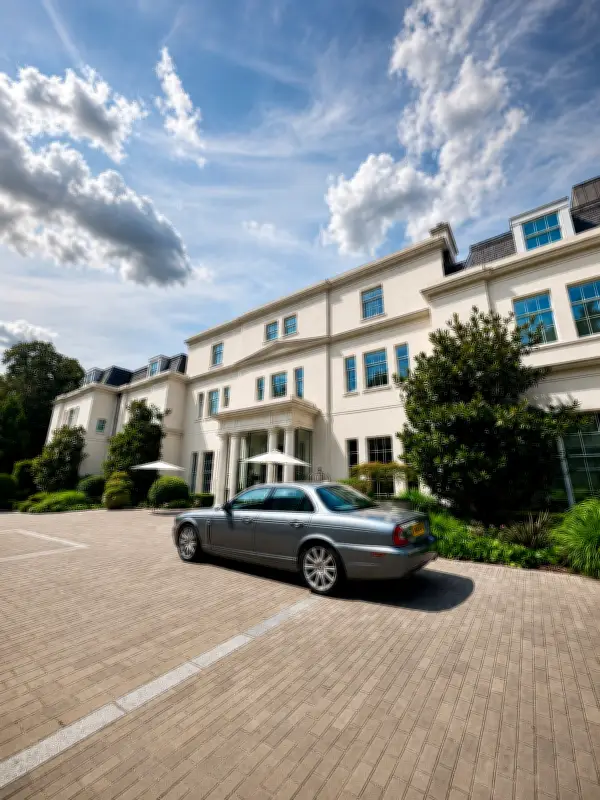
As we pulled away from Kingston, the Jaguar's warning panel lit up like a Christmas tree. Every fault appeared except 'Abandon all hope'. Five country houses, hundreds of miles, dinners and deadlines suddenly depended upon a dashboard which had selected the first minute of the journey for mutiny. We pulled over, switched it off, waited, and switched it on again. The warnings vanished; they never returned.
Our 2007 Jaguar XJ6, Lunar Grey with an ivory cabin, had travelled 70,000 miles and returned to Britain from Japan in better condition than many humans of comparable age. It is the opposite of the slab-sided, high-riding boxes multiplying across British roads, cars designed as though their chief duty were storming a retail park. Walnut crosses the dashboard; an analogue clock keeps company with a speedo converted to miles per hour; Japanese decals survive beneath the bonnet. Modern cars ask drivers to master menus. The XJ asks only to be driven.
Gravetye Manor
Relais & Châteaux has long proposed its Routes du Bonheur - journeys which disclose a country through independently minded hotels and restaurants rather than joining points on a map. The idea suits an old Jaguar whose pleasure lies not in arriving fast, but well.
Gravetye Manor, a Relais & Châteaux member, was built in 1598 for ironmaster Richard Infield, when the Weald's furnaces supplied cannon and shot, and became Britain's first country-house hotel in 1958. Its force, however, comes from William Robinson, born into poverty in famine-era Ireland and trained as a garden boy. He rose through writing and publishing, founding and editing The Garden and producing more than 70 books. The fortune earned by his pen enabled him to buy Gravetye, where he put into practice his belief in hardy plants, naturalised planting and gardens governed by soil and season. It was the only garden he made for himself.
Head Gardener Tom Coward, accompanied by his Welsh sheepdog Gwyneth, led us uphill to the elliptical walled kitchen garden, which Robinson established after trying three sites before settling upon this warmer position halfway up the valley. Within its sandstone walls, rotational beds of salads, roots, brassicas, legumes and cucurbits mingle with herbs, trained fruit trees and cut flowers. Elsewhere, a Peach House, glasshouses and orchard extend the harvest through the seasons, from tomatoes to dozens of apple varieties. Together they produce what Tom calls 'flavours you can't buy'. Lyra tasted blueberries before Tom gave her a fragrant blackcurrant bush. She carried it away as though she had acquired the freehold. 'Give a man a blackcurrant and he'll eat for a day,' he said. 'Give a man a bush and he'll have blackcurrant jam for the rest of his life.'
In the dining room, Claire Basler's botanical paintings were echoed by cut flowers which appeared to have stepped out of their canvases. Martin Carabott served garden tomatoes with white peach and black olive sorbet, Sussex chicken blanketed with black truffle, then an apricot soufflé which seemed not merely to be made from the fruit but to have captured its essence. Head Sommelier Federico Oddo turned pairings into blind-tasting games, entrusting Lyra with the answer. She nearly burst from the effort of keeping it secret. 'I love this game,' she announced, having enjoyed several minutes watching her parents fail.
Beaverbrook
Beaverbrook remains unmistakably the domain of Lord Beaverbrook - newspaper proprietor, political operator and one of Churchill's closest wartime allies. Its Spitfire emblem recalls his role as Minister of Aircraft Production, while the private cinema screened newsreels for Beaverbrook, Churchill and their circle. Its light fittings, we were told, came from the Empire State Building. Beyond the house lies a golf club whose joining fee has been reported at £305,000, making the old Jaguar look like the week's economy option.
We stayed in The Dowager, the suite named after Beaverbrook's widow, with a curtained four-poster, balconies over the Italian gardens and Louise Bourgeois in the bathroom. Lyra preferred the library. In many hotels, such rooms consist of hardbacks selected by the metre and never opened. Here she found an old book of tennis clippings. Later, the house manager researched the players and slipped the findings beneath our door - more memorable than any branded bookmark or pillow spray.
Lunch at the Japanese Grill produced an outstanding sea bass, marinated for 72 hours until yielding and deeply aromatic. At Sir Frank's Bar, Head Sommelier Giovanni Tallu supplied the afternoon's best line. 'Give me a budget and tell me the grape variety,' he said. 'I will find you an exceptional glass.' His guiding principle was better still: 'If it is not good for my palate, it is not good for my client.' Dinner at The Garden House peaked with smoky, savoury tomatoes before honeycomb gelato was claimed by Lyra. Beaverbrook turns political history into confident hospitality without resembling the expensive airport lounge increasingly replicated across luxury hotels.
Lympstone Manor
The longest drive carried us to Lympstone Manor, where the XJ made distance feel like someone else's problem and its icy air-conditioning made the scorching summer briefly theoretical. In the rear, Lyra disappeared into Aesop's Fables. On the final single-track approach, oncoming cars obligingly pulled aside for the stately Jaguar, granting it the sort of deference no modern SUV could reasonably expect. Years earlier, I had travelled to Monza with founder Michael Caines, then cooking for the Williams team. Lympstone was our second Relais & Châteaux stop; Caines now serves as the association's UK and Ireland delegate. Arriving at his vineyard hotel continued the conversation, only now the pace was measured in vines rather than lap times.
At Beaverbrook, the Spitfire had been an emblem. At Lympstone, a fortnight before our arrival, one had flown overhead as the Celebration of Speed filled the lawns with supercars and Formula One machinery, Jenson Button among the hosts. Our XJ would have been neither the fastest nor the most valuable car there, which was precisely its appeal: one electronic tantrum, no pit crew.
Once a seaside retreat for the Barings banking dynasty, the house later became a corporate conference centre. Caines bought it in 2014 and planted his vineyard four years later, its rows descending towards the Exe estuary. I subsequently joined the dosage trials for the first Lympstone Manor Classic Cuvée. On our return, the sea reached us through the vines. The grounds remain agreeably free of hotel bureaucracy: tennis rackets require no booking, the pool imposes no family hours, and swings stand beside prized vines, as though children and Chardonnay have negotiated a truce.
Dinner joined vineyard and kitchen. Lyme Bay lobster with mango, lime, fulsome lobster jelly and Oscietra caviar met Langham Rosé; Cornish turbot followed with scallop mousseline and chive butter sauce. Pink pigeon with celeriac, truffle and Madeira jus accompanied Lympstone's own 2024 Triassic Pinot Noir, harvested in November after a wet summer. The wine was young, but its point was already clear. Jaguar once proved a home-grown marque could become an international benchmark. English wine can now do the same.
Four Seasons Hampshire
Turning east from Devon, we reached Four Seasons Hampshire. The land appears in the Domesday Book, and Katherine of Aragon first met Arthur, Prince of Wales, here. Yet the hotel's strength lies less in history than in attention.
Lyra made her first attempt at fly-fishing. Instructor Richard began with protective glasses and a warning: a cast fly can travel at almost 100mph. The summer heat had driven the fish into deeper water, so he supplied the morning's philosophy. 'The definition of a pessimist is an experienced optimist.' Optimism prevailed. One trout eventually took Lyra's fly. She held it briefly before release and remarked upon its slipperiness, a quality widely understood in principle and rather less manageable in the hand.
Back at the house, concierge Man produced a dinosaur excavation kit, which Lyra attacked in The Bar at Wild Carrot while Surinder Virk made her a strawberry and blood-orange Oakwood Spritz. During dinner, Executive Chef Talha Barkin invited her into the kitchen and made fresh truffle pasta. Every strand disappeared. Head Sommelier Kadek Swijana later returned with an enormous bottle of Taylor's 20 Year Old Tawny Port, marking the hotel's anniversary. Luxury hotels often mistake activities for hospitality. Four Seasons understood the difference: trout, dinosaur, spritz, kitchen tour and a tawny bottle almost as large as Lyra. Outside, deer crossed the park. Inside, a substantial hotel somehow felt personal.
Coworth Park
Our last stop was Coworth Park, Dorchester Collection's country-house hotel and the only UK hotel with its own polo fields and practice facilities. I have long admired Adam Smith's Michelin-starred Woven. This time, we returned for the second summer of TIDE, his open-air restaurant running Friday to Sunday until 23 August.
Before lunch, we moved to the polo field to watch Eleventine face Watchcentre. The thud of hooves proved more stirring than most hotel playlists. Lunch around two mirror-black pools began with cocktails drawing on the estate itself, including its honey. Head Sommelier Nikos Emner's list treated English wine as an extension of the larder, reaching from Gusbourne's Guinevere Chardonnay, known as 'Gwin', to library releases of coastal Rathfinny. Rathfinny sparkling wine also appeared in an oyster with Mangalitsa 'nduja, cheese and pickled lime: hot, rich, saline and superb.
A raw scallop came with tomato, vanilla and basil; som tam with dried shrimp delivered exhilarating heat; 'chip shop' turbot held pearlescent fish beneath pristine, brittle batter; whole lobster arrived with coriander, lemon verbena, fennel and ginger. After lunch, we walked through the kitchen garden, where gardener Rosemary gave Lyra an estate wineberry vine and seeds from Coworth's wildflower meadow. Added to the blackcurrant bush from Gravetye, they left the Jaguar looking less like a grand-tourer than a garden centre which had unexpectedly specified leather seats. The wineberries returned in Woven with yuzu posset and caramelised-croissant-infused ice cream - though strawberries may soon replace them, Lyra having apparently eaten the rest of the crop.
Home in its own skin
Across the journey, the Jaguar stood apart from the automotive monoculture of swollen grilles, high waistlines and near-identical SUVs. Its appeal lay in remaining recognisably itself. Later, we read an editor's account of crossing France in a contemporary Bentley shaped like a massive suppository and felt happier still about our decision not to explore such a vehicle.
Each house had changed without surrendering what made it individual. The Jaguar offered the opposite lesson: it had barely changed at all. Its wood, analogue dials, low-slung profile and long bonnet now appear almost radical because everything around them has. Perhaps luxury is not the newest object, the largest screen or the fastest route, but something made well enough to acquire character and valued enough to be kept. By the time we returned to Kingston, the warning panel remained dark. Behind us sat a blackcurrant bush, a wineberry vine and meadow seeds. Five country houses, one old Jaguar, no recovery truck: the long bonnet brought us home.