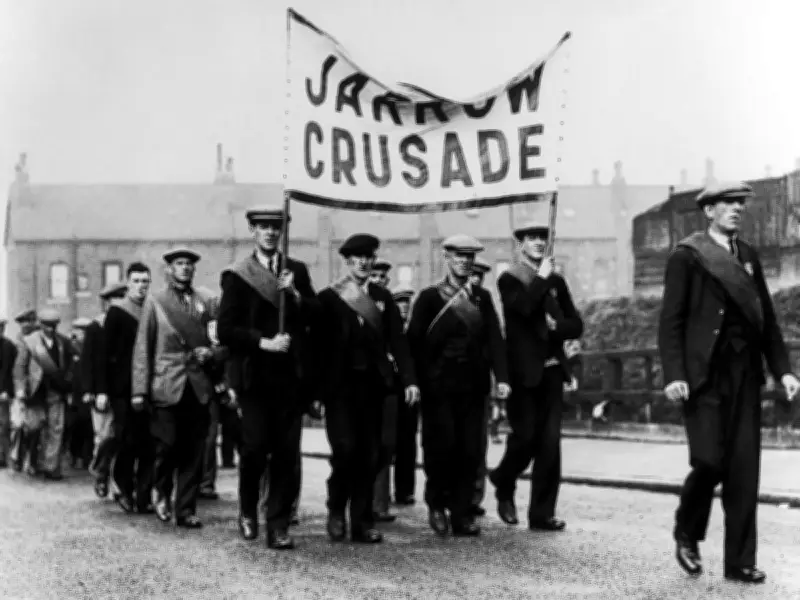
On the edge of the 1960s-built shopping centre, outside Morrisons supermarket, a bronze sculpture of five figures and a dog stands mid-stride, the historic Jarrow Crusade frozen in a moment of time. Passing shoppers probably don’t give the memorial a second glance, but this month marks the 90th anniversary of one of the last century’s most socially significant episodes.
The March Begins
Across Britain’s traditional industrial heartlands, the mid-1930s remained a period of profound economic struggle. On a rainy October 5, 1936, 200 men - led by the town’s fiery Labour MP, Ellen Wilkinson, and kept in step by a simple mouth-organ band - set off on foot from a community devastated by unemployment and hardship.
Their destination was London, 290 miles and a gruelling three-week march away. Their demand, backed by a petition signed by 12,000 townspeople and carried in a wooden box, was unequivocal. They wanted work, and the re-establishment of industry in Jarrow.
That day’s Evening Chronicle reported how the marchers, after attending a service at Christ Church with the bishop and mayor present, were given a “rousing send-off”. A single-deck bus, hired for £100, had been converted into a camp kitchen to accompany them on the road.
The Impact of the Shipyard Closure
Local historian and photographer Paul Perry, himself born and raised in Jarrow, explains the background: “When Palmers’ shipyard and steelworks - the town’s main employer - shut in 1934, the impact was devastating. Whole families and whole streets, some 10,000 people, were thrown out of work overnight.
“The crusade was a dignified march for work, and a protest against the unemployment and poverty that followed. Ironically, before Palmer’s closed, Jarrow had been a thriving town, with full order books, busy pubs, and bustling shops.”
In today’s very different world, iconic black-and-white photographs and grainy film footage of the proud Jarrow Crusaders on the move with their banners still carry poignancy and power.
The Journey to London
After leaving the town, the marchers reached Chester-Le-Street on the first night. A week later they were in Leeds, and another week took them to Loughborough. Finally, after 21 days of slog, the weary men marched into London on October 26.
Once in the capital, the atmosphere changed. After three weeks on the road, through towns where crowds had cheered and fed them, London’s welcome was noticeably cooler. The men gathered at Marble Arch, but the Government refused to meet them. Tory Prime Minister Stanley Baldwin was “too busy”, and the petition was received in the Commons but not debated.
A furious Ellen Wilkinson called the refusal to engage “an insult to the people of Jarrow”. The men were housed in a disused workhouse in south London before returning home by train, their wooden petition box intact but their hopes unmet.
Legacy and Commemoration
Ninety years later, as it slips ever further into history, what is the legacy of the Jarrow Crusade? If in the short term it did not achieve what it set out to do, in the longer term it helped bring about a new consensus on welfare.
The years after World War II saw the introduction of the welfare state, the NHS, secondary education until the age of 16, and national insurance - reforms that affected all of our lives. In the end, the men of Jarrow did not change their world overnight but they helped shape the one that followed.
Kate Osborne, MP for Jarrow and Gateshead East, said: "The Jarrow Crusade is one of the defining moments in the history of our town and something that people in Jarrow remain incredibly proud of. In the depths of the Great Depression, with the shipyard closed, mass unemployment and families facing terrible poverty and the indignity of the means test, 200 men marched nearly 300 miles to London.
“Alongside them was Jarrow’s remarkable MP Ellen Wilkinson, who fought tirelessly to make sure the voices of her constituents were heard. They demanded the dignity of work, the chance to provide for their families and for their community not to be abandoned.
“Ninety years on, the Crusade also reminds us how much Britain changed in the decades that followed. The hardship experienced in places like Jarrow became part of the national story that led people to demand better: full employment, stronger rights and protections, and a welfare state there for people when they needed it.
“The values the marchers represented - dignity, solidarity and the belief that working-class communities deserve a voice - remain as relevant as ever, and that spirit is still deeply woven into Jarrow’s identity today.”
A number of events are taking place to commemorate the Crusade’s 90th anniversary. Among them, on October 3 and 4 between 10am and 2pm, a free exhibition of photographs, stories and memorabilia will be on show at Jarrow Town Hall on Grange Road.