Standing on a cliff edge with the sun scorching my neck, the scene looks like a history tour of Kourion, an ancient Greek city-state near Limassol, Cyprus's second city. But technically, I am in the United Kingdom.
I have travelled to Cyprus to cross Britain's strangest land border. There are no officials checking passports, no signs, no flags — nothing to indicate you are crossing from the Mediterranean island's sovereign territory to another country's land.
The Sovereign Base Areas
When Cyprus gained independence from Britain in 1960, the Crown kept control of two significant chunks, equivalent to 3% of the land area. These were named Sovereign Base Areas, or SBAs. Akrotiri, the Western SBA, borders Limassol directly, and in the east, near the UN-administered buffer zone with northern Cyprus, is Dhekelia, the Eastern SBA.
I am at Akrotiri. In March, at the start of the US-Israel war on Iran, a drone strike near this British RAF base raised safety concerns across the Eastern Mediterranean. Currently, there is no suggestion that it faces any threat. Locals seem surprised to see a tourist — I am told the area has virtually zero visitors.
A border that doesn't make sense
Because the border is so low-key, I have to guess when I actually enter. Unlike the border in Nicosia, known as the 'Green Line' because it was sketched with a green pencil during intense violence between Greek Cypriots and Turkish Cypriots, there are no markers. You have to look at your GPS to know you're moving from 'British Zones' back into Cyprus.
I am crossing at Kolossi, a village on the outskirts of Limassol with a 13th-century castle built by Crusaders. Looking out over the Mediterranean, I am technically in the same country as my family over 2,000 miles away.
A bizarre side hustle
The base is a strange place. It has an environmental education centre, a botanical garden, and flamingos at the nearby Salt Lake, all while RAF jets deafen in the background. The environmental centre has a viewing point with telescopes for spotting flamingos, seashells, rare birds, and sea turtles.
The base is also home to the UK Government's Darwin Initiative, a habitat restoration project funding environmental and biodiversity conservation, such as protecting endangered sea turtle populations. Signs warn tourists that messing with turtle hatching will be reported to the sovereign base area police.
Pubs and West Ham fans
Close to the airbase, on Queen Elizabeth Street, is a pub called The Hamlet. Staffed by Brits — all West Ham fans, apparently — bartenders speak London English and switch to Greek when locals come in. The menu includes English breakfasts, Greggs sausage rolls, and pints of Carlsberg, alongside Greek staples like souvlaki and Cypriot Halloumi.
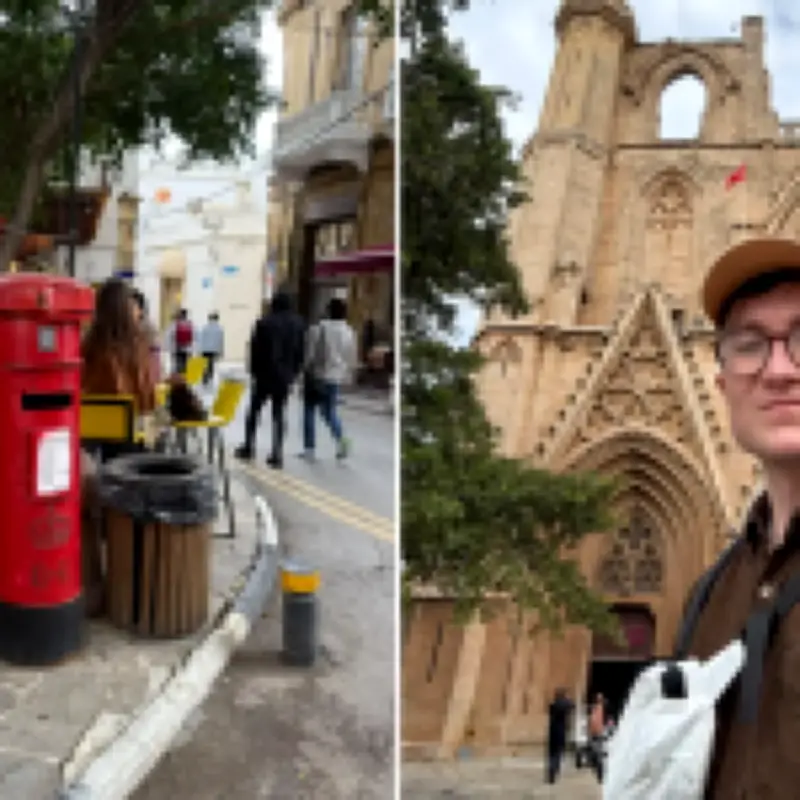
Premier League matches are shown on TV, but staff say they rarely see international visitors because the place is not on the tourist beat. Outside, red Royal Mail postboxes identical to those across the UK stand at British pedestrian crossings in the middle of Cyprus. Back at the pub, I charge my phone without a European adapter.
On both sides of the border, it feels 80% like the Mediterranean and 20% like the 1970s UK — not like entering or leaving either country, just stuck in the past.