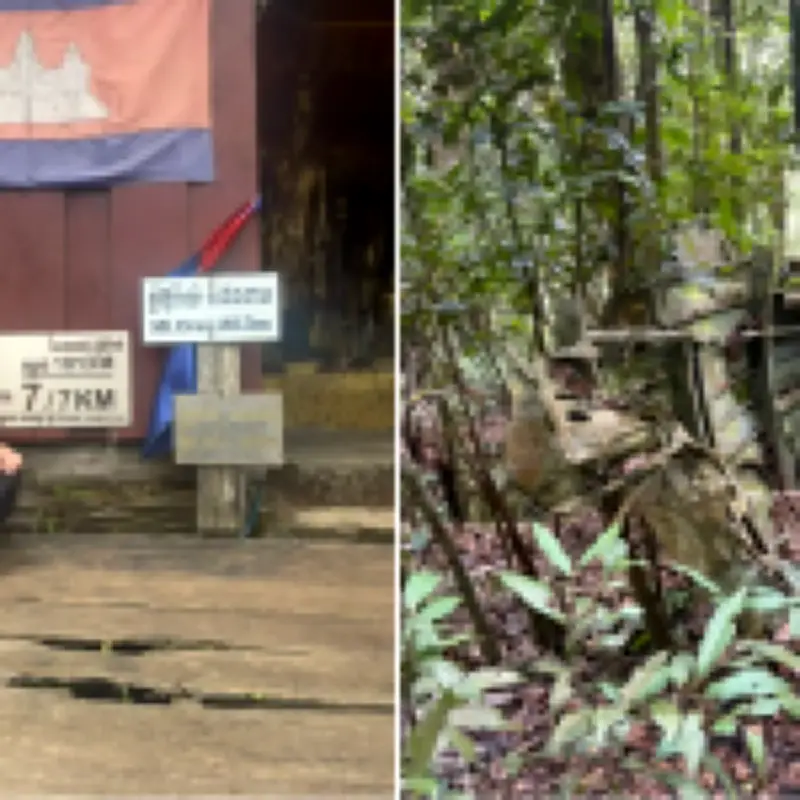
A hiker exploring Cambodia's highest mountain, Mount Aural, stumbled upon a remarkable piece of history: a military transport plane wreck from the 1974 civil war, preserved in the jungle for decades.
The Discovery
While most visitors head to Cambodia for Angkor Wat, Sadie Whitelocks, a freelance writer with a hobby of climbing the highest peaks, found herself trekking through dense rainforest. With a local guide, Pu Makara, she spent five hours covering 15km to reach the summit, communicating via walkie-talkie with another guide, Lina Seanglay, who stayed at base camp due to illness.
On the descent, Lina suggested a different route, promising something special. Emerging from the trees was an enormous aircraft, wedged between boulders, its aluminium shell covered in moss and vines. The Curtiss C-46 Commando transport plane had been untouched for decades.
The Crash Site
Local accounts say the plane crashed on Christmas Day in 1974 during Cambodia's civil war, between the Lon Nol and Pol Pot regimes. An estimated 11 people were on board—one pilot, one crew member, and nine military passengers. It is believed no one survived, though some may have escaped the wreckage only to be lost in the jungle.
The site was discovered by villagers years later, but due to the conflict, few records exist. It began attracting adventurous hikers in the early 2000s, yet official information remains scarce.
Investigation Clues
Aviation accident investigator David Gleave of Aviation Safety Investigations believes the wreck could still offer clues. "There may still be physical evidence that allows investigators to begin building a picture of what happened," he says. The bending of propellers could indicate engine power or failure, and the lack of post-impact fire means evidence might survive.
The C-46, built in 1943, predates black boxes, so investigators would rely on the wreckage itself. The mountainous location also poses questions: "Mountains generate turbulence and powerful wind effects that can make climbing difficult," says Gleave, and older navigation equipment could be distorted by terrain.
Survival and Recovery
Survival chances are hard to gauge. Dense forest can absorb impact energy, but mountainous jungle is different. The fragile nose section would have reduced crew survival odds, though passengers further back might have fared better. Even if survivors existed, the jungle and ongoing war would have made recovery nearly impossible.
Gleave wonders if an investigation was even feasible: "Was there even an accident investigation authority operating effectively in Cambodia at the time?" Unlike modern aircraft with satellite tracking, 1970s planes could vanish without a trace.
Today, such historic wrecks are increasingly rare. Standing beside the aircraft, reclaimed by the rainforest over half a century, one can only ponder the secrets inside its fuselage—a monument to a mystery that may never be fully solved.