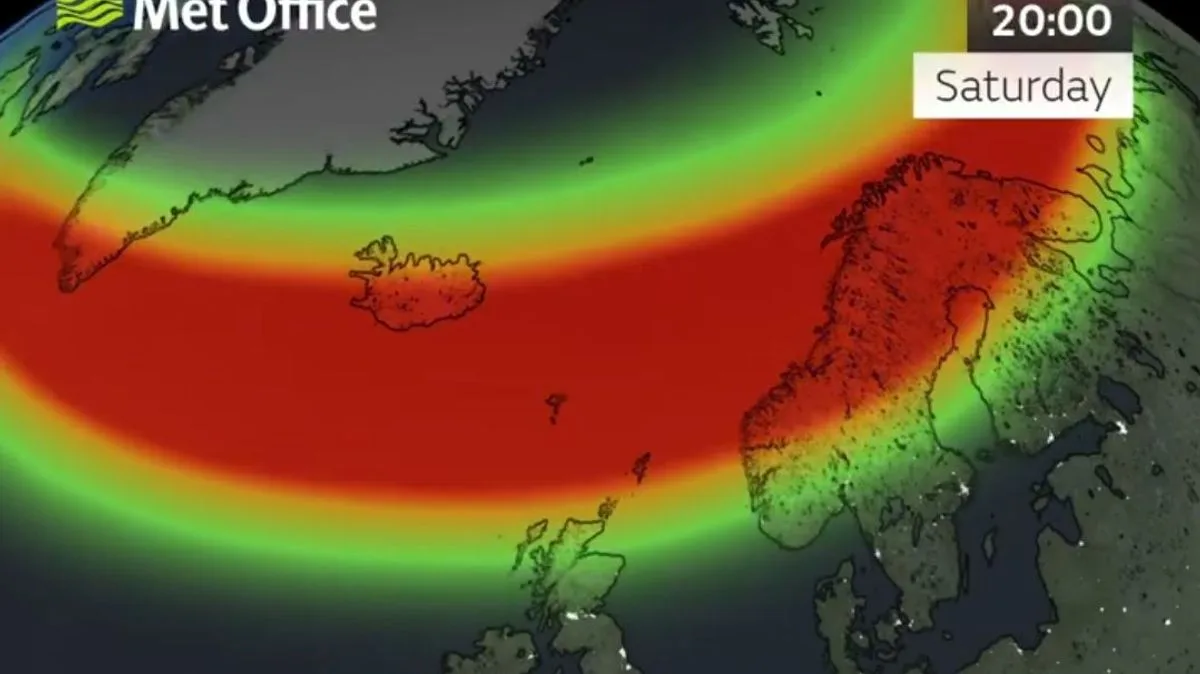
Met Office Maps Indicate Northern Lights Could Illuminate UK Skies Within Hours
The Met Office has released updated forecasts indicating that the spectacular Northern Lights, or aurora borealis, may be visible across parts of the United Kingdom tonight and potentially into Saturday evening. According to the national weather agency, regions in Scotland and northern England are most likely to witness the celestial display, provided conditions align.
Solar Activity Drives Aurora Potential
This opportunity arises from expected coronal mass ejections (CMEs), which are massive explosions of plasma and magnetic fields from the Sun's corona. These events often accompany solar flares and can travel at speeds up to 3,000 kilometres per second. When CMEs interact with Earth's magnetosphere, they trigger geomagnetic storms that produce auroras, though they also pose risks to satellites and power grids.
The Met Office's latest space weather forecast for the Northern Hemisphere states: "Multiple Coronal Mass Ejections may arrive during 20–21 March, plus a solar wind enhancement is expected to connect to Earth during 21 March." It adds that periods of enhanced auroral visibility are likely over the following nights, especially Friday and Saturday, with clear skies allowing sightings in Scotland and possibly northern England.
Viewing Tips for the Northern Lights
To maximise chances of seeing the aurora, the Met Office advises:
- Seek a clear night with minimal cloud cover.
- Find a dark location away from light pollution.
- Look toward the northern horizon.
- Be aware that geomagnetic activity can disrupt satellite navigation systems like GPS.
This follows earlier sightings in Cornwall this year, demonstrating that auroras can occasionally reach southern UK latitudes under strong solar activity.
Weekend Weather Brings Snow Warnings Alongside Aurora
Interestingly, the aurora forecast coincides with predictions of wintry weather. The Met Office reports that despite this week recording the hottest day of the year so far, some parts of the UK could experience snow this weekend. Cloud and patchy rain are expected to move southeastwards across the country on Sunday, with scattered showers in the north that may turn to snow over higher elevations.
Met Office Chief Forecaster Steve Willington commented: "While the early part of the period brings warm sunshine for many, it’s not unusual to see colder spells and even some wintry showers in March. As we head into next week, a shift to a cooler north‑westerly flow will bring a drop in temperature and more unsettled weather, including some hill snow in the north and brisk winds at times. This pattern is entirely typical for the time of year."
Thus, Britons might witness a rare combination of auroral displays and late-season snowfall, highlighting the dynamic and unpredictable nature of early spring weather. Enthusiasts are encouraged to monitor local forecasts and space weather updates for the best viewing opportunities.