A partial solar eclipse will be visible across the UK on Wednesday, August 12, 2026, with the Moon passing directly between the Sun and Earth, casting a dramatic shadow over the Northern Hemisphere. In many UK locations, more than 90 per cent of the Sun's visible disc will be covered, with the greatest coverage in the south-west of the British Isles, according to the Royal Observatory Greenwich.
Timings Vary by Location
The eclipse will begin, reach its maximum, and end at different times depending on where you are. The following timings are based on data from the astronomical tracking site Time and Date, which allows users to find precise information for their location.
England
- Birmingham: 91% coverage, starts 6.15pm, max 7.11pm, ends 8.05pm
- Bristol: 92% coverage, starts 6.17pm, max 7.13pm, ends 8.07pm
- Cornwall: 95% coverage, starts 6.18pm, max 7.15pm, ends 8.09pm
- Liverpool: 91% coverage, starts 6.13pm, max 7.10pm, ends 8.04pm
- London: 91% coverage, starts 6.17pm, max 7.13pm, ends 8.06pm
- Manchester: 91% coverage, starts 6.13pm, max 7.10pm, ends 8.03pm
- Southampton: 92% coverage, starts 6.18pm, max 7.14pm, ends 8.07pm
Scotland
- Aberdeen: 89% coverage, starts 6.06pm, max 7.03pm, ends 7.57pm
- Dundee: 90% coverage, starts 6.07pm, max 7.04pm, ends 7.59pm
- Edinburgh: 90% coverage, starts 6.08pm, max 7.05pm, ends 8.00pm
- Fort William: 91% coverage, starts 6.06pm, max 7.04pm, ends 7.59pm
- Glasgow: 91% coverage, starts 6.08pm, max 7.06pm, ends 8.00pm
- Inverness: 90% coverage, starts 6.05pm, max 7.03pm, ends 7.57pm
- Lerwick: 88% coverage, starts 6.01pm, max 6.58pm, ends 7.52pm
Wales
- Aberystwyth: 93% coverage, starts 6.15pm, max 7.12pm, ends 8.06pm
- Bangor: 92% coverage, starts 6.13pm, max 7.10pm, ends 8.04pm
- Cardiff: 93% coverage, starts 6.16pm, max 7.13pm, ends 8.07pm
- Colwyn Bay: 92% coverage, starts 6.13pm, max 7.10pm, ends 8.04pm
- Newport: 93% coverage, starts 6.16pm, max 7.13pm, ends 8.07pm
- Newtown: 92% coverage, starts 6.15pm, max 7.11pm, ends 8.05pm
- Swansea: 93% coverage, starts 6.16pm, max 7.13pm, ends 8.07pm
Northern Ireland
- Armagh: 93% coverage, starts 6.10pm, max 7.08pm, ends 8.03pm
- Belfast: 93% coverage, starts 6.10pm, max 7.08pm, ends 8.03pm
- Craigavon: 93% coverage, starts 6.10pm, max 7.08pm, ends 8.03pm
- Lisburn: 93% coverage, starts 6.10pm, max 7.08pm, ends 8.03pm
- Londonderry: 93% coverage, starts 6.09pm, max 7.07pm, ends 8.02pm
- Omagh: 93% coverage, starts 6.10pm, max 7.08pm, ends 8.03pm
Total Eclipse Elsewhere
A total eclipse, where the Moon completely covers the Sun, will be visible from parts of northern Spain, the north-east corner of Portugal, eastern Greenland, western Iceland, northern Russia, and the Atlantic Ocean.
Safety Warnings
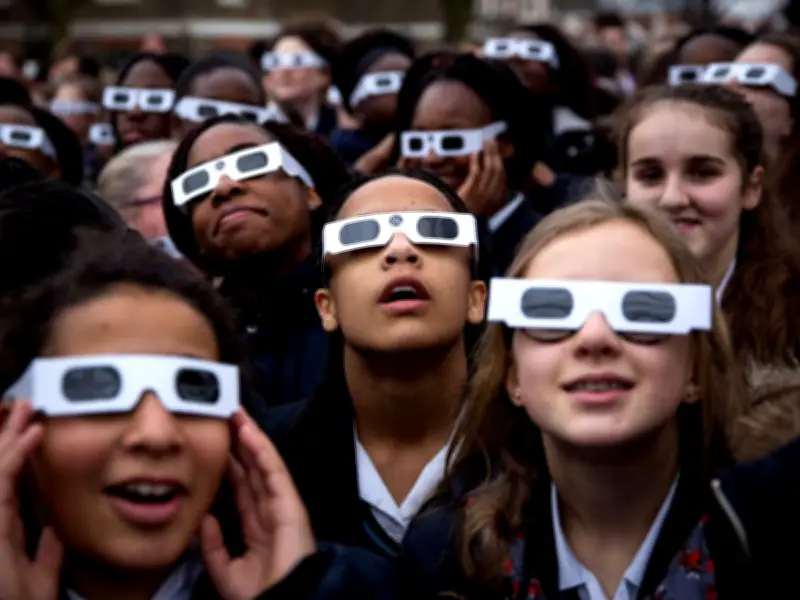
Health officials advise using specially designed eclipse glasses or handheld solar viewers to protect your eyes from harmful solar radiation. The UK Health Security Agency warns that ordinary sunglasses, no matter how dark, do not provide adequate protection. The Royal College of Ophthalmologists reported around 70 cases of vision problems after the 1999 solar eclipse, with about 40 per cent of those affected having observed it for less than a minute.
Ensure eclipse glasses are genuine and comply with the international safety standard ISO 12312-2:2015(E), with the certification code printed on them. Alternatively, you can make a pinhole projector, use a colander, or watch the eclipse online via live webcasts from the European Space Agency, NASA, or the Virtual Telescope Project.