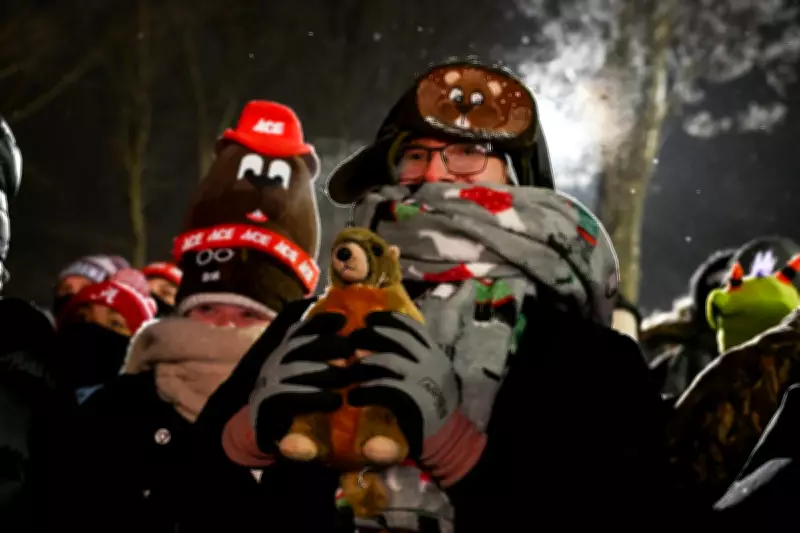
Tens of thousands of spectators have assembled in rural Pennsylvania, eagerly awaiting the annual meteorological prediction from Punxsutawney Phil, the celebrated groundhog who resides in a customised tree stump habitat. This peculiar tradition, which dates back over a century, will determine whether the United States can expect an early spring or must endure six further weeks of winter chill.
The Annual Ritual at Gobbler's Knob
The focal point of the festivities is Gobbler's Knob, where Phil's handlers from the Punxsutawney Groundhog Club—distinguished by their traditional top hats—will interpret the animal's behaviour. According to longstanding custom, if Phil emerges and sees his shadow, the forecast calls for six additional weeks of winter weather. Conversely, should he fail to see his shadow, an early spring is supposedly imminent.
Interpreting 'Groundhogese'
The club members insist they can decipher Phil's communications through what they term "groundhogese," a language comprising winks, purrs, chatters, and subtle nods. This interpretation forms the basis of the annual prediction, though sceptics frequently question how a groundhog might convey shadow observations to human companions.

Scrutiny of Phil's Accuracy Record
While the event maintains its charm and draws massive crowds, scientific analysis casts doubt on its predictive reliability. The National Centers for Environmental Information, operating under the National Oceanic and Atmospheric Administration (NOAA), conducted a comprehensive review comparing Phil's forecasts against actual U.S. national temperature data over a decade.
The findings revealed a mere 40% accuracy rate, challenging the groundhog's reputation as a reliable weather prognosticator. Furthermore, Phil demonstrates a distinct bias toward predicting extended winter conditions, doing so far more frequently than forecasting an early spring.
Historical Roots and Cultural Significance
The tradition originates from Pennsylvania German settlers in the late 1880s, who marked the occasion with picnics, hunting expeditions, and groundhog feasts. The Punxsutawney Groundhog Club, formally established in 1899, now cares for Phil in a specially designed enclosure adjacent to the Punxsutawney Memorial Library, complete with a viewing window into his burrow.
Groundhog Day occurs annually on February 2nd, precisely midway between the winter solstice and the spring equinox. This date holds significance in various cultural calendars, including ancient European farming traditions, the Celtic calendar, and the Christian observance of Candlemas.
Beyond Punxsutawney: A Widespread Phenomenon
Although Punxsutawney's celebration remains the most famous, similar groundhog prediction events occur throughout North America and beyond. The 1993 film "Groundhog Day," starring Bill Murray, significantly boosted the festival's profile, transforming it from a local custom into an internationally recognised phenomenon.
As the crowd awaits Phil's emergence, the blend of folklore, community celebration, and gentle scepticism continues to define this unique American tradition, regardless of its meteorological accuracy.