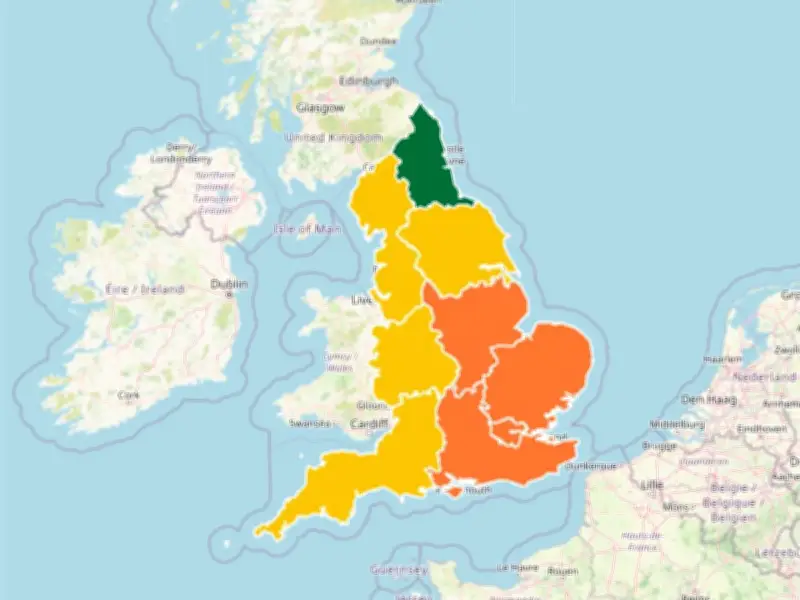
The 72-hour yellow heat-health alert covering Greater Manchester came into effect at 9am today (August 3) and is expected to last until 9am on Wednesday (August 5). Greater Manchester was added to the alert on Sunday afternoon, when the warning was updated to include north west England; it had not been part of the original alert.
The yellow warning applies across the North West, Yorkshire and Humber, South West and West Midlands. The UKHSA warns that impacts are likely across health and social care services, including increased use of healthcare services by vulnerable people, a greater risk to life for vulnerable people, an increased potential for indoor environments to become very warm, and a possible rise in water-related incidents.
Heatwave temperatures expected
At its peak, temperatures are forecast to hit 30C in Greater Manchester, while parts of southern England could reach 33C. Greater Manchester is expected to meet its heatwave criteria of three consecutive days above 25C, with highs of 25C on Monday, 30C on Tuesday and 25C on Wednesday.
The Met Office said the upcoming "hot and humid" spell is not expected to last long, with some "scattered thundery downpours" also on the forecast. Rain would likely be a welcome addition for many, as large parts of the UK are in a drought following weeks of dry and hot weather, with water restrictions in force for millions of people.
Amber alert in southern England
A more significant amber alert is in force for the same period across the East Midlands, East of England, London and the South East. The UKHSA warns that significant impacts are likely across health and social care services due to the high temperatures.
Potential impacts listed by the UKHSA include a rise in deaths, particularly among those aged 65 and over or with health conditions, as well as possible impacts on younger age groups; likely increased demand on all health and social care services; internal temperatures in care settings such as hospitals and care homes exceeding the recommended threshold for clinical risk assessment; heat affecting the ability of the workforce to deliver services; indoor environments overheating and increasing the risk to vulnerable people living independently in community and care settings; issues managing medicines; staffing issues due to external factors such as transport; increased demand for power exceeding capacity; impacts in other sectors such as travel delays; and an increase in water-related incidents, including risks from cold-water shock and drowning.
Areas covered by the warnings
The full list of areas under the yellow alert is: North West, Yorkshire and Humber, South West and West Midlands. The amber alert covers: East Midlands, East of England, London and South East.
Only the North East of England is left without a warning over the coming days, as temperatures there are not forecast to reach as high.