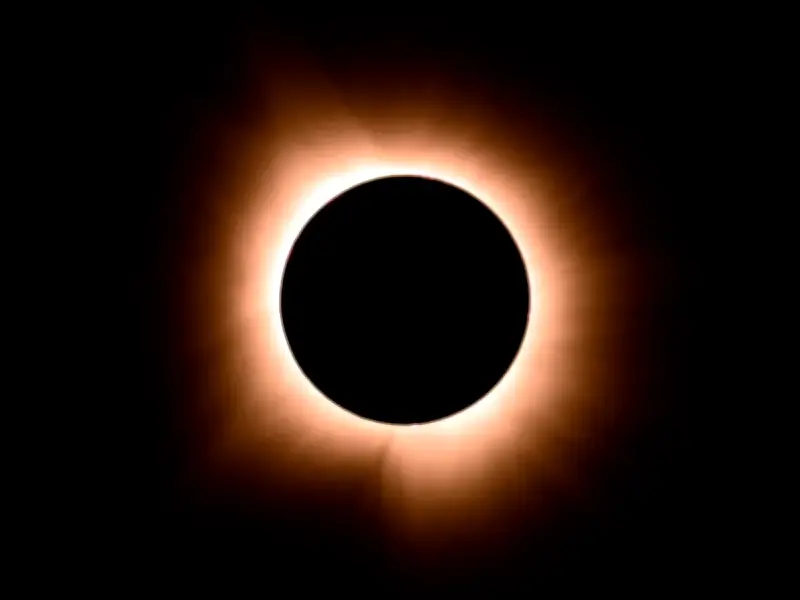
The UK is set to experience its most significant partial solar eclipse in nearly 30 years this Wednesday, with the moon covering between 90% and 96% of the sun depending on location. This will be the most visible eclipse in the UK and Ireland since 1999, and another with this much coverage won't occur until 2050.
Celestial Event Coincides with Perseid Meteor Shower
This solar eclipse is particularly exciting as it coincides with the Perseid meteor shower, which peaks overnight on 12-13 August. The Perseids are a well-known meteor shower linked to the comet Swift–Tuttle.
A solar eclipse occurs when the Moon moves between the Sun and Earth, blocking some or all of the Sun's light. During a total solar eclipse, it gets almost completely dark, while partial eclipses make the sky look more like twilight. The shadow has two parts: the umbra, where all sunlight is blocked, and the penumbra, where only some sunlight is blocked, creating a partial eclipse.
Partial Solar Eclipses Are Common, but Rare for Specific Locations
Partial solar eclipses are relatively common, with roughly 35% of all solar eclipses being standalone partial eclipses. However, according to the Natural History Museum, a total solar eclipse at any specific location on Earth is rare, occurring on average only once every 400 years. The next total solar eclipse visible from the UK won't be until 23 September 2090.
Much of Europe, including the UK, along with parts of Canada, the northern United States, and northwest Africa, will see a noticeable partial eclipse. In the UK, London and Edinburgh are expected to have about 91% coverage, Belfast 93%, and Newcastle 92%. In Wales, the eclipse will be visible from 6:13pm to 8:06pm, with Cardiff seeing about 93% coverage.
Timing and Coverage Vary Across the UK
The exact time and amount of coverage will vary depending on location. The eclipse will start on Wednesday, August 12th, just after 6:08 PM BST in Scotland, at 6:16 PM in Cardiff, and around 6:17 PM in London.
Safety First: How to View the Eclipse Without Harming Your Eyes
Experts warn that looking directly at the sun during the eclipse without proper protection can harm your eyes. Wales Online reports that after the 1999 total solar eclipse, the Royal College of Ophthalmologists reported around 70 cases of vision problems, with about 40% of those having looked at it for less than a minute. The Royal Greenwich Observatory also warns that regular sunglasses are not safe enough.
Imo Bell, a planetarium astronomer at the observatory, told the Press Association: “It’s not a total eclipse, but over 90% is really exciting. We’re not going to get one this good for a really long time. So it’s important not to miss it, and to be prepared. You can’t just go out and expect to have a look because it’s really dangerous for your eyes. So you can use solar eclipse glasses, which are very, very different from sunglasses – they block out so much light that you can’t see anything through them except the Sun, because that’s how much light they need to block for the damaging light of the Sun to be safe to view. Ideally, a solar telescope is an amazing way to witness it, and if you don’t have one of them, then you can look into whether your local astronomy society is doing any events. And if all else fails, you can project the image of the eclipse using a household item like a colander, which has lots of holes in – point the colander towards the Sun with your back facing it, and in the shadow of the colander you’ll be able to see the eclipse in the holes, which is really cool.”
Use eclipse glasses with special filters that meet the ISO 12312-2:2015(E) safety standard, or use handheld solar viewers.
Weather Forecast and Best Viewing Spots in Wales
The UK Met Office says it’s too soon to know exactly where skies will be clearest for the eclipse. Their long-term forecast suggests the north may have more showers and wind, while the south could see warmer, drier weather.
Since the eclipse happens late in the evening, the best way to see it is to find a spot with a clear, open view of the west-northwest horizon. Space.com highlights three places in Wales as perfect for watching: Gwynedd’s Llŷn Peninsula, Rhossili Bay, and Strumble Head. Strumble Head in Pencaer, Pembrokeshire, will have the best view in Wales, with 94% coverage at 7:13pm. Space.com says: "Strumble Head offers one of the clearest west-facing horizons in Wales, with the eclipsed sun appearing above the Irish Sea beside its iconic lighthouse." The remote coastline experiences very little artificial light, helping preserve dark skies after sunset, and after the eclipse, it's an excellent place to watch the Perseids.
Craig Goch Dam in Rhayader is another excellent spot, offering an elevated view at 312 metres above sea level. After the eclipse, you can enjoy views of the Milky Way and the Perseid meteor shower, which peaks between midnight and 5:30 AM.