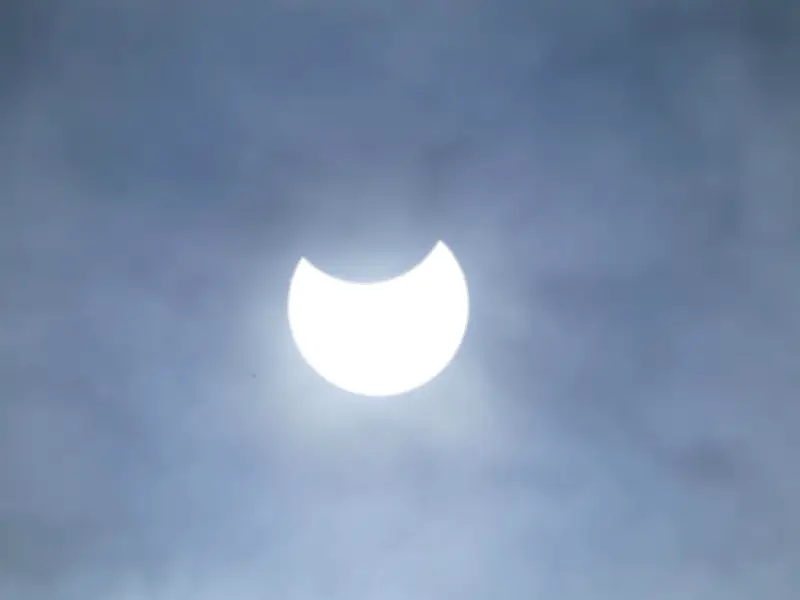
More than 90% of the Sun will be engulfed by shadow next week in what is predicted to be the fullest solar eclipse for the next 54 years. The generational event will take place on the evening of Wednesday, August 12, and will be the most complete eclipse seen in UK skies in 27 years.
What will the UK see?
The last time the UK witnessed a solar eclipse of this magnitude was on August 11 1999, when the Sun was totally obscured by the passing moon. While there have been solar eclipses since then, including a partial one in March last year, next Wednesday will see a far bigger portion of the Sun covered - more than 90%. The entire event is set to last about one hour and 50 minutes, starting at about 6.20pm and finishing by 8.10pm.
Why do solar eclipses happen?
A solar eclipse occurs when the Moon passes between the Earth and the Sun. Because the Moon is much smaller than the Earth, its shadow only covers a small area of the Earth's surface, meaning any solar eclipse will only be visible from a certain part of the planet.
Wednesday's solar eclipse will appear as a total eclipse (covering all of the Sun) in parts of Greenland, Iceland and Spain. In the UK, a large part of the Sun will be covered. On the other side of the world in Australia, however, people will have to wait another two years for a solar eclipse. A total eclipse is on course for Australia, Antarctica, and parts of Asia on July 22 2028.
There are between two and five solar eclipses each year with a total eclipse taking place every 18 months or so.
What about lunar eclipses?
A lunar eclipse, meanwhile, occurs when the Earth lies directly between the Sun and the Moon, casting a shadow onto the Moon's surface. This often causes the moon to appear orange or red, and is also known as a "blood moon".
A partial lunar eclipse happens when the Moon passes only partially through the darkest part of the Earth’s shadow (the umbra), meaning only part of it will appear tinged red. A penumbral lunar eclipse occurs when the Moon travels only through the outer part of the Earth's shadow, resulting in a paler orange or yellow tone that is easy to miss.
Next lunar eclipse in the UK
According to Royal Museums Greenwich, the next visible lunar eclipse in the UK will by a partial eclipse taking place on August 28 this year. Starting at 3.33am, the Moon will begin to move into the Earth's shadow, reaching its peak at 5.12am, when approximately 90% of the Moon will be in the umbra.
After this, the Moon will slowly move out of the umbra until the eclipse ends around 6.15am. The Moon will be increasingly low on the horizon as the event progresses, so you'll need to find a high point with a clear view to the southwest to get the best view.