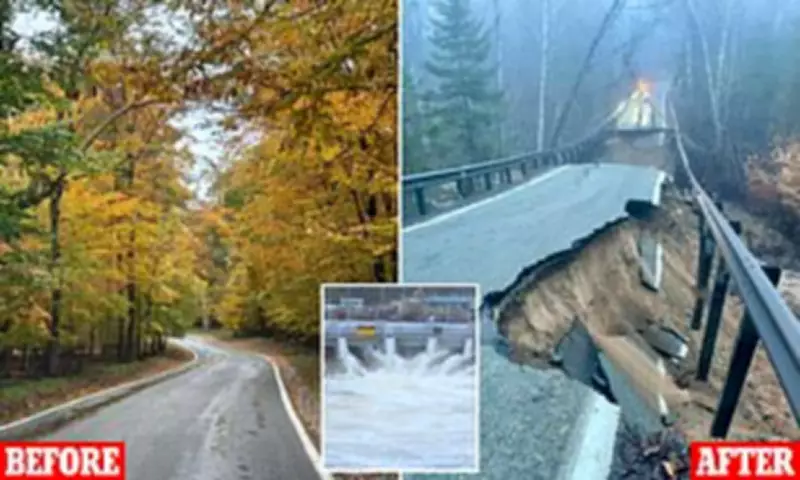
Michigan's 'Tunnel of Trees' Roadway Collapses Amid Severe Flooding Crisis
A picturesque section of Michigan's iconic 'tunnel of trees' roadway has been transformed into a massive crater following a sudden collapse triggered by rain-induced erosion. The incident has occurred as a dangerously high water level at the Cheboygan Dam threatens residents living downstream, prompting urgent evacuation preparations.
Road Closure and Immediate Impact
The Emmet County Sheriff's Office abruptly closed Highway M-119 between Island View and Division Road last week after part of the scenic route collapsed, presumably due to flooding. This 20-mile stretch along Lake Michigan is a beloved scenic drive, now rendered impassable in both directions. Authorities have strongly advised motorists to seek alternative routes to avoid the extensive road damage.
Showers and snowmelt from a March winter storm significantly worsened flooding conditions over the weekend. As of Sunday, parts of Emmet County had already received approximately one inch of rainfall, with forecasts predicting additional precipitation. The heaviest rain was expected to impact the M-72 corridor and southern Lower Michigan, potentially mixing with snowfall as temperatures drop.

Dam Emergency and Evacuation Warnings
Officials first issued warnings about rising waters on April 7, when the water level at the Cheboygan Dam was measured at 21.5 inches below its top. By Monday morning, the Cheboygan River had risen to 13.75 inches at the dam, escalating concerns. Residents below the dam have been urged to:
- Sandbag their homes and secure outdoor items
- Move valuables to higher levels
- Prepare for potential evacuation
In response, the Michigan Department of Natural Resources activated five pumps on Sunday to divert water around the dam. Richard Hill, Gaylord District Supervisor for the DNR's Parks and Recreation Division, stated, 'All of the dam gates on the DNR-managed portion of the dam are fully open to handle this flow. The pumps add to the capacity. We are putting through as much water as we can.'
Broader Weather Threats and Regional Impact
The National Weather Service has issued a flood watch for the northern half of Lower Michigan and the entire Upper Peninsula. Severe thunderstorms are forecast to hit on Monday evening, persisting through the night, with another wave expected on Tuesday evening bringing winds, hail, and possible tornadoes.
Approximately 1.4 inches of rain is predicted to fall across the state, with some areas potentially receiving up to 2.5 inches. By Thursday, Michigan could see around 2.8 inches of rain, winds reaching 60 miles per hour, and possibly one-inch hail. The NWS noted that water levels were already rising due to previous rainfall on 'already saturated ground,' increasing the risk of destructive flooding.
Additional Dam Concerns and Safety Measures
As of Monday, several rivers and dams, including Cheboygan, Tippy, and Mio Dam, are under flash flood and flood warnings. In the northern Lower Peninsula, the Tippy Dam in Manistee County and the Mio Dam in Alcona and Oscoda counties have been opened to release water, which is expected to cause flash flooding downstream. Officials have advised residents living below these dams to move to higher ground and avoid driving through flooded roadways.
Crews are collaborating with the Federal Energy Regulatory Commission, which regulates the dam, to explore options for reopening a hydroelectric generation station to facilitate additional water movement. Hill added, 'Our objectives for this incident are to work closely with FERC and the operators and owners of the hydro building to look at options. Some water is going through the bypass valves on that part of the dam.'
Rains are anticipated to continue through Wednesday and Thursday, with West Michigan under a level one risk for severe storms. Forecasts indicate one to two inches of rain could fall, exacerbating the already critical situation. The NWS emphasized that multiple rounds of rain are expected across northern Michigan throughout the week, with totals exceeding one inch likely in some areas, particularly south of M-32.