In the mid-1980s, John Giddings flew to Los Angeles, climbed into a 'huge limo with purple seat cushions', and was driven to Prince's house. He cannot quite recall the location—'Laurel Canyon or somewhere'—but he distinctly remembers the artist opening the front door and greeting him in a squeaky voice. 'He was tiny. And wearing these little clicky black heels.' Prince asked what he wanted to drink. Giddings requested coffee. 'And Prince, I mean, I swear to god it was like he didn't live there. So he tiptoes off, probably looking for a kitchen, and comes back 20 minutes later with two tea bags. And he said, "John, English breakfast or Darjeeling?"' The musician had never brewed coffee before and was baffled by the process. 'I mean, f**king Prince!'
Giddings, now 73, is arguably Britain's most prominent music agent. At his London office for Solo, the walls and corridors are adorned with framed posters of tours he has organized: David Bowie, the Rolling Stones, Madonna, Mariah Carey, Beyoncé, Spice Girls, Lady Gaga, U2, Céline Dion. Also displayed are all the line-ups for the Isle of Wight Festival, which he has helmed annually since 2002. This year's festival, running from 18 to 21 June, is headlined by Lewis Capaldi, Calvin Harris, and The Cure. Next year marks the 25th anniversary of his stewardship, after which he plans to retire. Married to Caroline, an ex-lawyer turned festival director, he has four adult daughters and splits his time between London and the Isle of Wight. 'It's my final fling,' he says of the 2027 edition. 'I'll have peaked and I don't want to be hanging around.'
Growing up in St Albans, Giddings attended Exeter University, ostensibly to study 'philosophy and sociology' but really because the campus boasted a large hall that hosted major artists. As social secretary, he booked Bob Marley, T-Rex, and Procol Harum over three years. He was once outvoted by the committee when he wanted to book David Bowie during the 1972 Ziggy Stardust tour. 'I had to go and see him at Torquay Town Hall.'

Times were different then, with artists more accessible. At Exeter, Giddings paid just £600 to book Genesis. He recalls entering the dressing room after the show, 'and they were all drinking cups of tea and bickering.' About what? 'Oh, they didn't think the lights were good enough.'
Graduating in 1975, he landed a £30-a-week job at the music agency MAM. 'It was a brilliant time to be in London. I signed acts left, right and centre'—including Adam and the Ants, Boomtown Rats, and X-Ray Spex.
By 1986, Giddings founded his own agency, Solo, securing gigs for Lou Reed, Iggy Pop, and David Bowie (now at Wembley, not Torquay). In 1990, he was invited to Canada to meet the Rolling Stones' manager, who tasked him with booking the band's European tour.
Giddings was exhilarated and eager to celebrate. But before he could reach the nearest bar, another promoter asked him to watch an unknown local girl sing at a 500-seat theatre. 'They gave me a ticket in the fourth row, and this woman sings for an hour and keeps looking at me. And I'm gagging for a drink.' Still, he listened—'she was obviously good'—and afterward met the singer and her team backstage. 'And they were wonderful. They said to me, "Can you get us a gig in London?" and I thought, I'll do anything [for you]!' That notably nice singer was Céline Dion, and Giddings went on to work with her for decades. In 1999, he arranged her sold-out 50,000-seat show in Edinburgh, 'and she said something that no artist has ever said to me before or since: "Are you making enough money?" And, stupidly, I said yes.'
Giddings speaks positively about nearly everyone. The Corrs? 'I love them dearly.' Pharrell Williams? 'A great bloke.' Mariah Carey? 'A right laugh,' actually. 'I got p**sed with her once in Cologne, we were dancing in a bar at two o'clock in the morning.' He also adores the Spice Girls, even if 'trying to get them to reform is like trying to catch water in a sieve.'

Prince, however, does sound tricky. After that LA trip, Giddings booked two shows for him at Wembley. But back then, Prince was refusing to be called Prince. 'And he'd said to me, "The poster will say—"' Giddings gestures with a hand swoosh '—"live [at Wembley]." And I thought, who the f**k will know what that means?!' He put the name Prince on the posters, sold half the tickets, and Prince duly cancelled. 'I had to sue him to get the money back.'
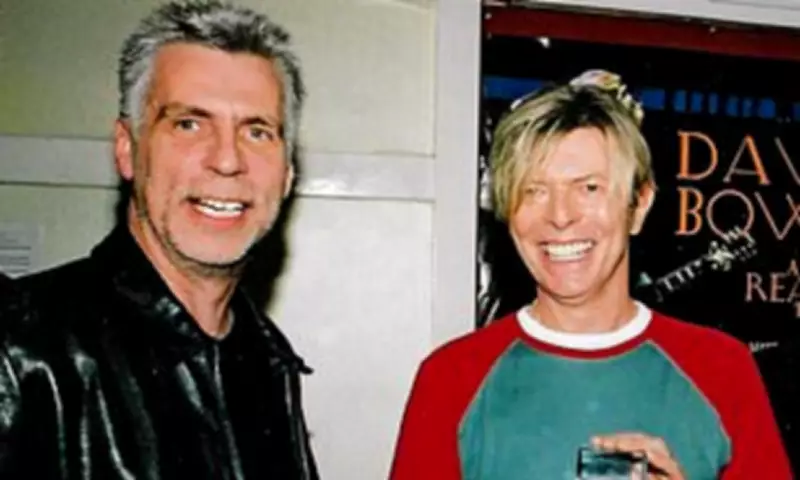
His hero was David Bowie. They met in 1977 when Bowie was playing keyboard on tour for Iggy Pop. 'He was just a class act,' says Giddings. 'David was a good bloke, really funny.' In 2000, Giddings arranged Bowie's now-famous Glastonbury set. There was tremendous back-and-forth: festival organizer Michael Eavis was unconvinced by Bowie's new music and made a 'poxy' offer; Bowie initially declined because his wife, Iman, was expecting a baby; Giddings had to lie and say Madonna would headline in his place; and so on. Eventually, Bowie agreed. As he was about to go on stage, he showed Giddings the setlist. 'And I nearly fainted, because it was just the most incredible thing I'd ever seen. He said, "What do you think?" And I said, "What do you mean, what do I think? That is [these songs are] my life!"' (The performance was 'obviously incredible', but Giddings' memory is tainted by a 'dodgy egg sandwich' he ate afterward, causing him to vomit in his car.)
The first Isle of Wight Festival took place in 1968 and became so successful that by 1970, Jimi Hendrix, Joni Mitchell, and Leonard Cohen played to crowds exceeding 600,000. Giddings, then 17, was there and remembers seeing all those revellers. 'It looked like the Battle of the Somme.' The event was subsequently banned by parliament until 2001, when the Isle of Wight council asked Giddings to organize its return the following year. It lost half a million pounds for the first two years, but in 2004, Giddings booked Bowie and The Who. The festival sold 35,000 tickets and broke even. 'So the rest is history.'
The constrained nature of the island means performers must cope with unglamorous circumstances. Mick Jagger stayed at the nearest Premier Inn, and after Jay Z's headline performance, the rapper dined with his wife Beyoncé at the local boat museum. Some stars make requests: Paolo Nutini's team asked 'for weed'; Paul McCartney's promoter inquired about last-minute acrylic nails. Giddings didn't know what those were and recalls standing 'in the middle of the field, looking in the Yellow Pages.' He found a beautician in nearby Cowes. 'So she comes with her vanity case, and sits backstage waiting for Paul McCartney. I thought [the nails] were for one of the backing singers, but they were for him. Because he strengthens his nails to play Yesterday on the acoustic guitar. Anyway, he was so kind to her. He had dinner with her afterwards.'
Then there were the Rolling Stones. On their arrival in 2007, Giddings arranged for two articulated lorries to be placed back-to-back in a field, with a running track laid down inside. 'Because he [Mick Jagger] likes to run for half an hour before he goes on stage.' Meanwhile, Keith Richards and Ronnie Wood requested a pool table to be installed so they could play before the show. 'So I hire a marquee and a pool table, and a bloke in a suit who levels the table. And they put these big things in the ground to hold the marquee up, screwing up the pavement—which I had to pay for after—and then they [Richards and Wood] just walked past it!' Giddings says all this while laughing and smiling.
In fact, throughout the hour-long conversation, he says almost everything while laughing and smiling. 'I am the luckiest man alive,' he concludes. 'I've had the best job ever.'