A Tennessee family miraculously survived a devastating tornado that leveled their home by taking refuge in an underground bunker, as a series of deadly storms brought chaos and destruction across the United States. This harrowing incident highlights the severe weather conditions that have impacted millions of Americans in recent days, leaving hundreds of thousands without electricity and disrupting travel on a massive scale.
Widespread Weather Chaos Across the Nation
The family from Bonnertown, Tennessee, was among the estimated 200 million Americans who have experienced extreme weather events over the past few days. These storms have created travel mayhem, with more than 4,700 flights canceled on Monday alone, and hundreds more axed on Tuesday as powerful weather systems swept through the eastern half of the country. The chaotic conditions have upended air travel in numerous cities, creating a cross-section of disruption from coast to coast.
Tornado Devastation in Multiple States
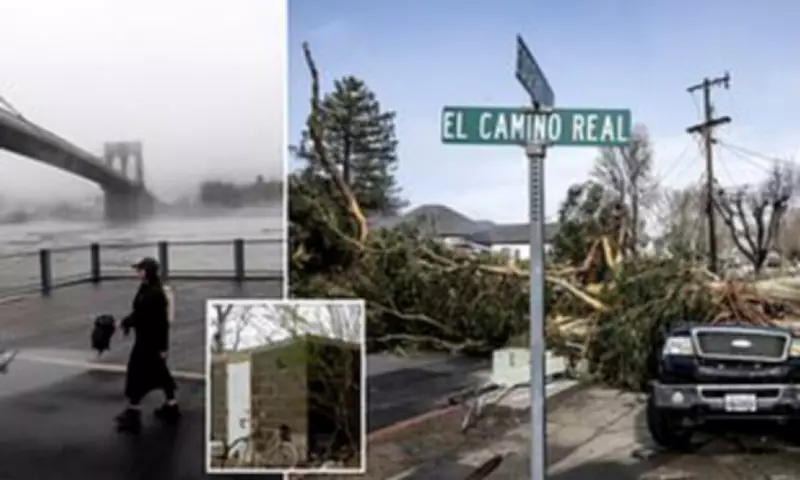
Severe weather spread through the eastern United States over the weekend, burying parts of the Midwest under snow and leaving towns and cities in ruins as tornadoes tore through Tennessee, Missouri, Illinois, and Arkansas. In Bonnertown, the family who lost their home sought shelter in their bunker after an EF1 tornado ripped through the area just after 11 PM on Sunday. The tornado caused significant damage, with at least ten homes and one business pushed off their foundations.

The severe weather continued into Monday, placing more than 95 million people under tornado watches from the Florida Panhandle through Georgia, the Carolinas, Virginia, Maryland, Washington DC, Delaware, eastern Pennsylvania, New Jersey, and parts of New York. Parts of the Eastern Seaboard remained under an enhanced storm risk heading into Tuesday, with forecasts predicting gusts of up to 55 mph, torrential rain, and powerful thunderstorms.
Confirmed Tornado Strikes and Damage
At least one tornado was confirmed to have struck Charlotte, North Carolina, where it ripped part of the roof off a longtime local business, according to Spectrum Local. The National Weather Service confirmed that an EF0 tornado, the highest rating for that category, hit at around 9:40 AM, bringing wind speeds estimated at 85 mph and damaging the roof of Superior Mechanical Systems. The tornado uprooted trees and caused damage to several homes in the city.
In Washington DC, high winds on Monday forced the federal government to tell employees to go home early, with both the House and Senate postponing votes due to the dangerous conditions. Meanwhile, torrential rains flooded homes and washed out roads in Hawaii, while dry and windy conditions fueled the largest wildfire in Nebraska's history.
Blizzard Conditions and Travel Disruptions
Blizzard conditions continued in the Upper Midwest and Great Lakes after the storm walloped parts of Wisconsin and Michigan with several feet of snow. Since Saturday, nearly three feet of snow has fallen in the northern Wisconsin town of Mountain. In Minnesota, the storm caused at least one fatal crash and led to 700 vehicles veering off the road.
Sergeant Troy Christianson with the Minnesota State Patrol told KEYC on Monday that these numbers were extremely high considering how many roads were closed. "I-90 and I-35 were just opened up this morning, but otherwise they were closed the majority of the weekend," he explained.
Wildfires and Further Storm Threats
Further south in Nebraska, dry and windy conditions were charging the largest wildfire in the state's history, with three different blazes consuming more than 1,140 square miles of mostly grassland on Monday. Nebraska Governor Jim Pillen remarked, "Mother Nature is throwing a doozy at us."
As the storm spread east, officials in New York City warned that strong winds could knock down tree limbs. Tragically, four people, including a child, died Monday afternoon in New York City after a fire in a three-story apartment building spread during heavy winds.

Hawaii Flooding and Infrastructure Damage
In Hawaii, unrelenting rains triggered landslides, washing away roads and flooding homes and farmland. All of Hawaii's islands had spots with more than 15 inches of rain, while parts of Maui were overwhelmed with double that amount, according to the National Weather Service. Konawaena High School's brand new football and track and field stadium even slid down a hill, with one longtime resident saying the area faced the worst flooding she had seen in 20 years.
Maui Mayor Richard Bissen reported there were no injuries or deaths from the flooding, and crews were assessing the damage. While the worst of the storm has passed, more heavy rain is expected later this week.
Flight Cancellations and Power Outages
Amid the wild weather conditions, more than 4,700 flights were canceled Monday as the Federal Aviation Administration ordered ground stops at Hartsfield-Jackson and Charlotte Douglas International Airport in Atlanta, Georgia, and ground delays at JFK International Airport in New York and Newark Liberty International Airport in New Jersey.
Hundreds of flights were still canceled or delayed on Tuesday as the dangerous weather passed, but a partial government shutdown strained screener traffic. According to flight-tracking site FlightAware, more than 590 flights scheduled to fly into, out of, or within the U.S. were called off as of early Tuesday, with over 780 delayed.
Simultaneously, more than 596,000 Americans remained without power early Tuesday, primarily in Michigan and Pennsylvania, according to PowerOutage.us.
Heat Wave Concerns in the Southwest
The wild weather conditions are not yet over, with a heat dome over the Southwest expected to push temperatures well into the triple digits in parts of the region, particularly in Arizona. California is also heating up, with the San Francisco Bay Area and Sacramento expected to see temperatures pushing toward 90 degrees Fahrenheit.
Los Angeles Mayor Karen Bass noted on Monday, "This is technically still winter. This is not normal for March, obviously, but it is a sign of how climate change is impacting our city." While temperatures are expected to reach 100 degrees Fahrenheit, the threat of wildfires around Los Angeles is relatively low because winds will be light.
AccuWeather meteorologist Dan DePodwin stated, "This is a heat wave that we have not seen before in recorded history in the Southwest." Phoenix is expected to have five straight days of triple-digit temperatures this week. DePodwin noted that only once before, in 1988, has the city recorded a 100-degree Fahrenheit day in March.