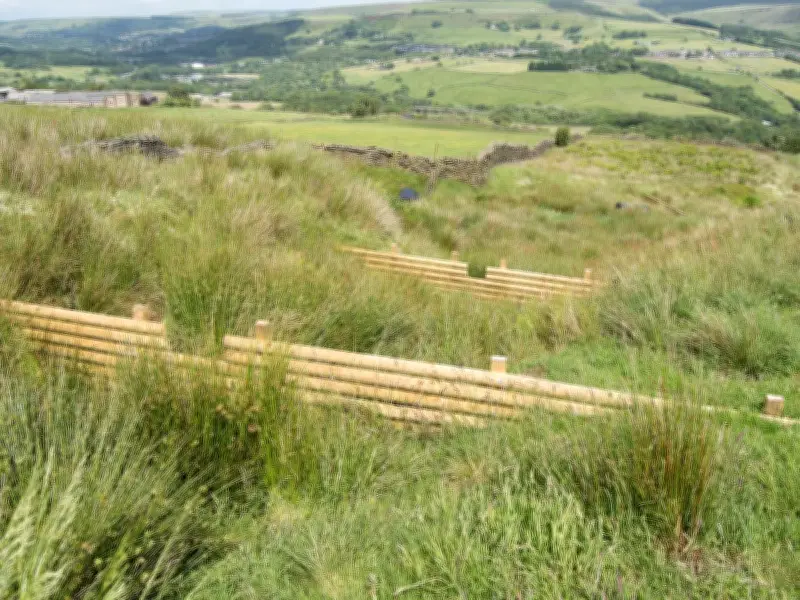
Work is under way to install 137 wooden “leaky dams” across the Stubbins Estate, above Ramsbottom, in a natural flood management project run by the National Trust and United Utilities.
The dams are designed to slow the flow of water running off the moors and hills, reducing flood risk downstream and improving water quality in the River Irwell and its tributaries. The work, led by contractor Aitch Conservation, is intended to store high-velocity run-off from intense rainfall temporarily and release it gradually.
Natural flood management
The National Trust said the intervention is an extension of previous restoration work to mitigate climate change, support farming and improve habitats across the estate’s moor, farm and woodland areas.
A National Trust spokesperson said: “The Stubbins estate is in the upper Irwell catchment, which lies directly below Holcombe Moor, part of the West Pennine Moors. Our work here is crucial to support the region’s nature, wildlife and people. Working alongside United Utilities, the Slow the Flow project builds upon our knowledge of natural flood management interventions and their effectiveness at reducing water flows both up and downstream. In total we’ll install 137 dams across moorland, farmland and woodland. Each type of dam is designed to either hold back or slow the flow of water. These types of dams, which are made up of horizontal wooden poles, are permeable allowing run off in normal conditions but restricting flow during high rainfall events. By enhancing the water storage capabilities of the land, limiting run off or slowing the flow of water, we aim to reduce the risk of flooding whilst at the same time maintaining and improving water quality.”
Monitoring and funding
Work on the wooden storm dams began in June. Monitoring of their effectiveness will include drones, fixed-point photography, flow monitors and an AI analytics tool for wastewater utilities called Storm Harvester. University experts will also analyse time-lapse footage, helping to show the relationship between uplands, natural flood management and drainage areas.
The project is funded by United Utilities’ Advanced WINEP (Water Industry National Environment Programme), part of which focuses on storm overflow improvements and environmental enhancement. The partners include the Environment Agency, Natural England, the University of Liverpool, the University of Manchester, local authorities and other interest groups.