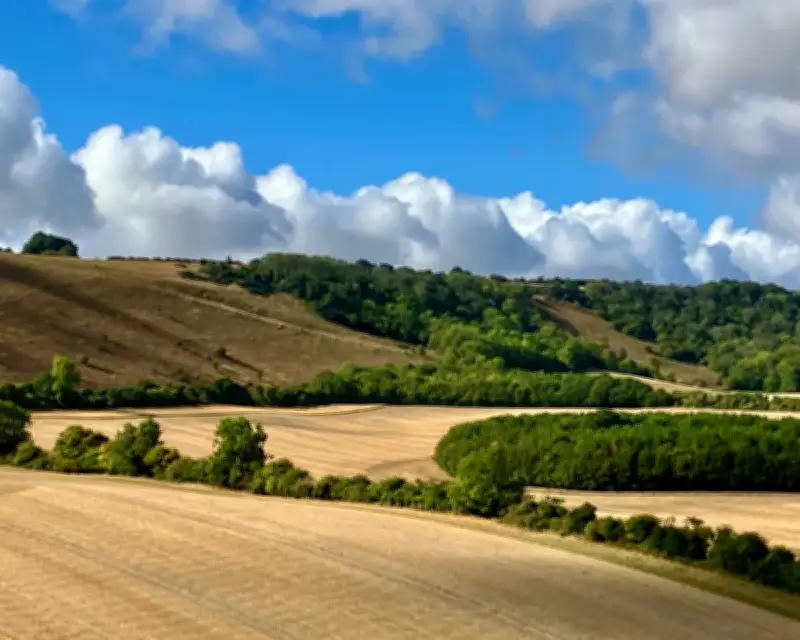
After an entire heat-baked summer without rain, the land looks strange and unlike itself. Fields, banks and grassy margins are the lurid yellow ochre of climate fiction – the mise en scène captured with eerie relevance in the recent BBC TV drama The Rapture.
A parched landscape
There are cracks so deep in Weaver’s Field that the farmer can push his arm in up to his elbow. Spots of bird’s-foot trefoil and sky-blue chicory (the latter on uncannily short stems) polka-dot the otherwise dead pasture. Sentinel field oaks seem unaffected, but shallow-rooted beech trees, familiar in giant caterpillar shapes on the downs, shed shrivelled brown leaves and a poor, early beechnut mast. Gnarly field maples are almost leafless, while sycamores bracket the green with their browning leaf-curl. Even in the keepered woods, laurel has wilted.
Smoke and fire
For a week, skeins of black smoke drift from the field fires at Enham Alamein, from the eastern end of Greenham Common, and from the New Forest further south. But over the nearby border into Wiltshire, it is white smoke that veils Salisbury Plain all the way to Avebury and its village in the stones. The Westbury White Horse, of Eric Ravilious’s 1939 painting, is on fire – or the down and iron age Bratton Camp next to it is. Probably carved from the chalk in the late 1600s, it is surrounded by an apocalyptic vision.

The smell of smoke lingers long after a fire is out. Dad was a fireman who fought the New Forest conflagration in 1976, and Windsor Castle’s blaze in 1992. For me, the smell of burning evokes heightened awareness, comfort and safety, an olfactory memory of him coming home from work in damp, sooty uniform, and the alarm bell that rang in my childhood home whenever he was needed.
Rain brings change
The rain teases us for a few more days, as towering piles of cumulus sail north like galleons. When it comes, it darkens the down to an unfamiliar moorland brown. The heat rises again afterwards, and with it the strong scent of ammonia from sheep’s urine. The only thing to wet the ground all summer, it had remained undiluted and on the surface. Reanimated, mingled with damp dust and baked grass, it’s a heady, confusing new scent.