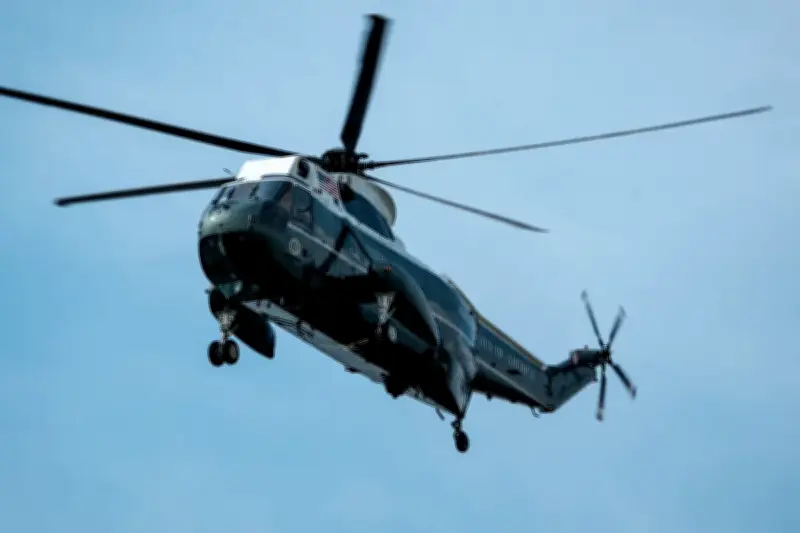
Safety officials say the relocation of a helipad amid Donald Trump’s multi-project White House reconstruction led in part to an incident earlier this month in which a military helicopter carrying the president came too close to a passenger jet.
A preliminary report published Thursday by the National Transportation Safety Board (NTSB) blamed “communication issues” for the failure of the crew of Marine One, the presidential helicopter, to give the required three minutes’ notice to air traffic controllers that they were about to take off from the White House.
Loss of separation
Consequently, commercial flights from nearby Ronald Reagan Washington national airport were not halted as they normally would be, and there was a “loss of separation” between the helicopter and an Embraer E170 jet operated by an American Airlines subsidiary taking off for Florida.
In May, helicopter flights were moved from the White House South Lawn to the nearby Ellipse, a small park immediately south of the White House, because of construction work. Projects under way include Trump’s controversial new ballroom planned to replace the east wing of the White House and a new helipad for Marine One to use.
Communication attempts
During the 4 August incident, the NTSB found, the Marine One crew attempted at least twice to radio controllers to give the required notice, but were unable to do so.
Bryan Bedford, head of the Federal Aviation Administration (FAA), said the agency relocated an antenna and changed procedure following the incident, and the NTSB said checks made after the relocation showed no subsequent communication issues.
However, the Associated Press reported Friday that air traffic controllers again lost contact with Marine One briefly on Thursday as Trump was heading for an event in Texas, adding that communication was quickly restored and there was no safety issue.
Back-up failure
According to the NTSB report of the earlier incident, air traffic controllers met with Marine One staff on 30 July, seeking “to discuss concern with recent reports of their not receiving the required ‘three minute to liftoff’ call”.
The Marine One crew responded that communications “had been spotty,” the report said, and they agreed to use other means of communicating with the tower in situations where they were unable to reach them.
But the back-up failed on 4 August when Marine One was also unable to contact controllers via a helicopter facility at Joint Base Anacostia-Bolling in south west Washington, DC, and the helicopter took off with Reagan traffic still departing.
Incident details
Marine One lifted off at 2.33pm, and the passenger jet one minute later. The Embraer was rerouted “out of caution” the NTSB said. At the time of the incident, an FAA statement said “it didn’t appear to be a dangerous close call and the aircraft weren’t apparently converging”.
FAA rules require aircraft to remain separated by at least 1.5 miles (2.4km) horizontally and 500ft (152m) vertically around airports. The NTSB said Marine One and the plane were at one point separated by 0.82 nautical mile (0.94 mile or 1.5km) laterally and 700ft (213m) vertically.
The episode followed a tightening of proximity rules in the wake of a January 2025 collision between a commercial airliner and an army Black Hawk helicopter over the nation’s capital that killed 67 people.
Meanwhile, a helipad under construction on the South Lawn to accommodate a new supersized Marine One helicopter is undergoing changes because Trump is unhappy with its appearance and an apparent slope, it was reported this month.