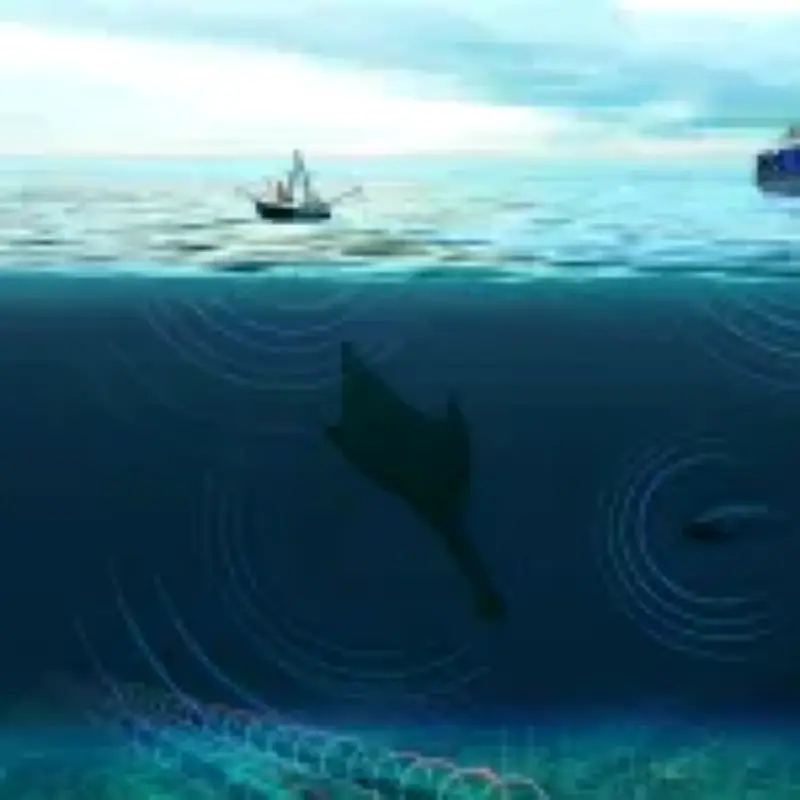
Undersea microphones are being developed to help protect the UK's £65bn network of critical cables from sabotage by Russia and other hostile states. The cables, which carry over 90% of the nation's daily internet traffic, are currently 'naked' and 'incredibly vulnerable' to attack.
Defence firm BAE Systems is developing vibration-detecting sensors for military use that will attach to the cables and catch oncoming threats. The technology, known as distributed acoustic sensing (DAS), can detect even the faintest vibrations near the cable affecting the fibres.
Turning vulnerability into a military asset
Researchers at BAE Systems want to revolutionise how DAS sensors are used so they can 'turn a cable running for hundreds of kilometres along the ocean floor into a continuous array of microphones'. The sensors would detect any vibration on the seabed near the cable, identifying 'everything from environmental shifts to the movement of vessels and even marine life'.

The sensors are already used widely on land and on a limited commercial basis underwater, but BAE wants to advance the technology for military purposes. Tim O'Neill, Subsea Intelligence lead at BAE Systems, said: 'There has been a real increase in the threat to this undersea infrastructure. It is no longer just benign accidents.'
Threat from Russia
Cables have long been at risk of accidental disruption, such as when ships drag their anchors or fishermen trawl the seabed, but hostile states are now seen as a major threat. Last week, Nato forces foiled a Russian subsea sabotage plot by chasing away ships in Arctic waters training to attack the cables with an undisclosed secret weapon.
Defence Secretary John Healey warned in Parliament last year that Russia was 'gathering intelligence and mapping' the UK's cable network. O'Neill explained how the technology could work: 'You will get an alert that something has hit the seabed at this position on the cable. DAS will be able to pick up that anchor dragging far enough away that you can tell the vessel to stop, or if that doesn't work, you still have time to send out military assets to intercept it.'
Data challenge and expert views
The tech is currently in its experimentation phase, with data being fed from a DAS sensor on a cable into BAE's AI and machine learning programmes. A single DAS unit can generate up to a petabyte of data per day, the equivalent of streaming 57 continuous years of high-definition video, so tools are being developed to identify signals of interest and alert the operator.
O'Neill added: 'The reality is that this is a state problem. If we can get this into the hands of the UK government to support their activity, trying to counter Russian threats, then we want to be part of that.' Alessio Patalano, who specialises in critical undersea infrastructure at King's College's War Studies Department, said the sensors provide 'persistent and consistent data on how to understand what's happening around the cable in a way that was impossible. It makes the seabed slightly more transparent, making it easier to understand where to operate, how to operate, and against whom you are operating. It will also improve the ability to recover from any interference with the cables, because you are going to be faster at identifying where the problem is and the best way to address it.'
The Ministry of Defence has been approached for comment.