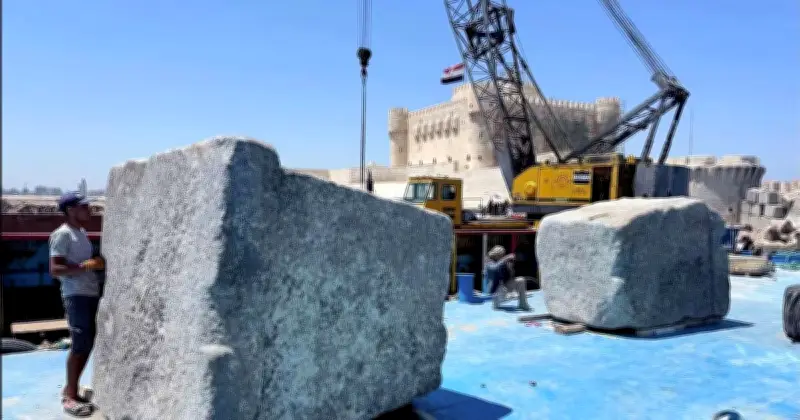
Archaeologists have recovered 22 massive stone blocks from the legendary Lighthouse of Alexandria, one of the Seven Wonders of the Ancient World, from the ocean floor. The blocks, including lintels, door jambs, and thresholds from the main entrance, were submerged in the Mediterranean Sea off the coast of Egypt. Large paving slabs weighing between 77 and 88 tons each were also discovered.
Pharos Project Aims for Digital Reconstruction
The recovery is part of the Pharos Project, an initiative involving France's National Center for Scientific Research (CNRS), led by archaeologist Isabelle Hairy, Egypt's Ministry of Tourism and Antiquities, and the Dassault Systèmes Foundation. The goal is to digitally reconstruct the monument using cutting-edge technology.
Each discovered piece will be scanned using high-precision photogrammetry to create a detailed three-dimensional model. The blocks will be analyzed and incorporated into the digital reconstruction like pieces of a puzzle. The project is the latest effort to digitize architectural fragments that remain underwater.
Historical Significance of the Lighthouse
The Lighthouse of Alexandria dates back to the early third century BC. Designed by the Greek architect Sostratus of Cnidus, it stood more than 300 feet tall on the island of Pharos at the entrance to Alexandria's harbor. It was the tallest human-made structure on Earth for centuries and served as a vital navigation tool for ships in the Mediterranean.
For over 1,600 years, the landmark guided mariners until it was destroyed by an earthquake in 1303. Centuries later, stones from the lighthouse were reused in the construction of the Citadel of Qaitbay, a fortress now standing on the same site.
Digital Database and Accurate Representation
The discovery will be added to a digital database that includes a wide range of historical sources, such as ancient coins, mosaics, and written accounts from contemporary chroniclers. It is hoped that this reconstruction will create the most accurate representation of the Lighthouse of Alexandria to date.