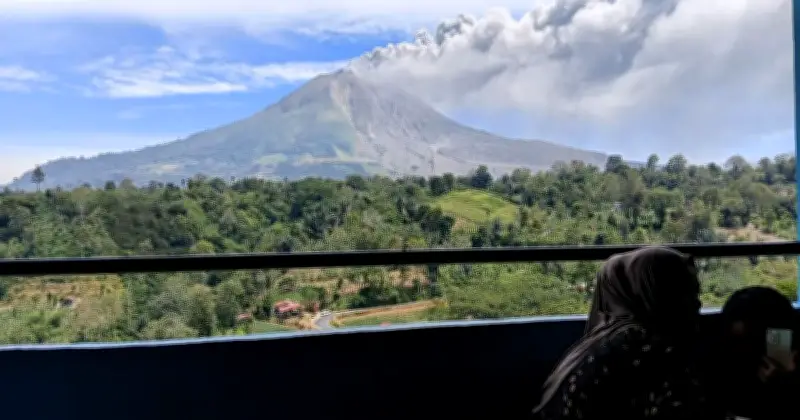
Mount Sinabung in Indonesia erupted on Monday, sending a dense plume of volcanic ash approximately 3.5km into the sky. The eruption prompted Indonesian authorities to urge residents and tourists to stay clear of the area.
Eruption details and official warnings
The volcano, located in Karo Regency in North Sumatra, began erupting at 10.17am local time. Officials warned of potential hazards from falling ash and increased volcanic activity around the crater.
Lana Saria, head of the national geological agency, said: “The ash column appeared black and thick, tilting towards the east and southeast.”
“This eruption was recorded on a seismogram with a maximum amplitude of 120mm and a temporary duration of approximately 1 hour, 1 minute, and 48 seconds,” Saria added.
Restrictions and safety measures
The Geological Agency urged residents and visitors to avoid activities in villages earmarked for relocation and warned against entering Mount Sinabung’s designated danger zone.
Authorities have banned all activity within a 3km radius of the summit, as well as within a 4.5km sector extending to the southeast, due to the heightened risk posed by the volcano's ongoing activity.
Residents living near rivers that originate from Mount Sinabung have also been advised to remain vigilant for potential cold lava flows, a hazardous phenomenon that occurs when heavy rainfall washes volcanic ash, rocks and other debris downstream.
Monitoring and increased seismic activity
The Karo Regency Government has been instructed to maintain close coordination with the Mount Sinabung Observation Post and the Centre for Volcanology and Geological Hazard Mitigation, as national and regional authorities continue to closely monitor the situation and assess any further risks.
The Centre for Volcanology had previously reported a significant increase in seismic activity at Mount Sinabung, with monitoring data showing a sharp rise in deep volcanic earthquakes and volcanic gas emissions between 1 and 12 August. Scientists also detected several low-frequency and hybrid earthquakes during the period, signals often associated with the movement of magma beneath a volcano.
The findings suggested growing pressure within the volcanic system and heightened unrest ahead of the eruption, prompting authorities to closely monitor the volcano's activity.