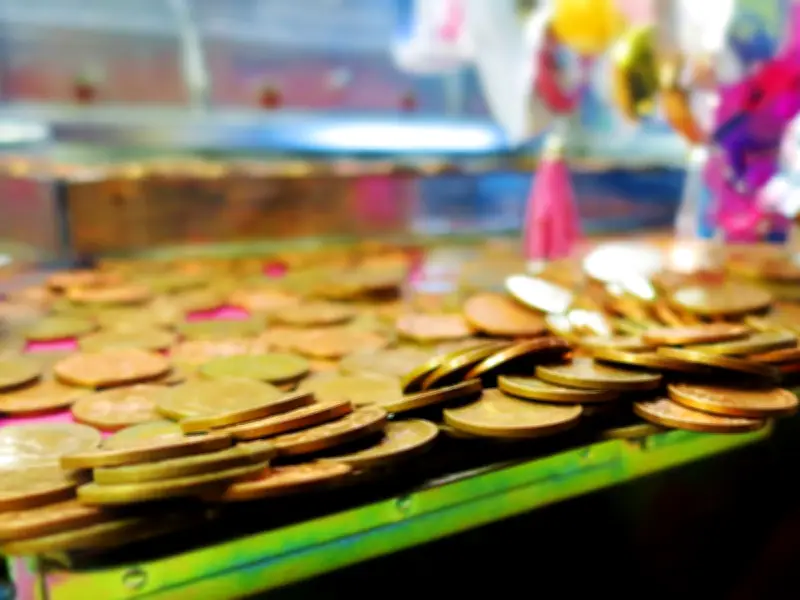
Gaming experts say the hot weather returning to the UK this weekend will create a specific set of circumstances that make it more likely you could win on 'Tipping Point' style coin pusher arcade machines. With coastal temperatures forecast to hit 32C and air-conditioned arcades running a full 8-10 degrees cooler inside, gaming experts at EsportsGG say the heatwave this weekend creates a very specific physics advantage at the penny coin pusher machine, and the coins already in your pocket are the key to it.
Thermodynamics Over Luck
Patrick Webb, Games and Arcade Expert at EsportsGG, said: “There’s a reason the penny coin pusher machine has been on British seafronts since the 1960s, it’s one of the few machines where genuine knowledge genuinely changes your odds. Most people feed in their 2ps hoping to nudge a coin waterfall over the edge. The savvy players aren’t looking at the coins at all. They’re looking at what’s sitting on top of them: keyrings, tickets, folded notes. Some of those machines have £20 notes clipped right there on the shelf. Nobody talks about this and it’s the single biggest thing separating a £1 loss from a £20 win.
“But this weekend there is something else at play that almost nobody knows about, and it is entirely down to the heat. Walk into a seafront arcade from 32C outside and your coins are warm. The machine’s tray is sitting in air-conditioned air at around 22C. That temperature gap between your pocket and that metal shelf changes the physics of the drop in a way that actually works in a player’s favour. It is thermodynamics, not luck. And it only applies on a weekend like this one.”
Six Expert Hacks for Beating Coin Drop Machines
1. Leave Your 2p Coins in the Sun for 10 Minutes Before Playing
This tip is uniquely relevant during this weekend's heat. With coastal temperatures forecast to reach 32C, most seafront arcades will be air-conditioned to around 22-24C, creating an 8-10C temperature gap. Leave your 2p coins in the sun for around 10 minutes before heading into the arcade, then keep them in your trouser pocket rather than a wallet or your hand to retain as much warmth as possible. Avoid using coins straight from the machine's change dispenser, as they'll already be at the cooler indoor temperature. When a warmer coin lands on the cooler metal tray, it creates a very slight thermal contraction, and published friction science shows that the coefficient of friction between metal surfaces is slightly higher at lower temperatures than at elevated ones. The effect is subtle, but if you're looking for every possible edge, this is one of the few tricks that's genuinely unique to a hot weekend like this.
2. Stop Targeting the Coin Waterfall, Target What’s Sitting on Top of It
Modern penny pushers are not just coin machines, depending on the arcade and the machine, the shelf can hold keyrings, prize tickets, folded £5 notes, and in some cases £20 notes, displayed flat and pressed under coins or propped at the edge. These are not decoration, as they fall when the coin mass beneath them pushes far enough forward. The mistake almost every player makes is feeding coins into the middle of the field trying to trigger a cascade. The correct approach is to identify where a non-coin prize is positioned, then build coin pressure directly behind it. One targeted run of 10p worth of 2ps behind a £20 note is a better investment than a £3 scatter approach across the whole tray.
3. The Coin You Drop Matters as Much as Where You Drop It, Aim for the Back Lip, Not the Centre
Most players drop coins over the centre of the tray, hoping for maximum spread. The correct target is the very back lip of the moving shelf, so that the coin lands just before the shelf reverses direction. A coin dropped at exactly that moment rides the shelf forward as it pushes, rather than being scooped backward. It is the difference between a coin that actively contributes to a forward push and one that simply adds weight in the wrong direction. Watch the shelf cycle two or three times before dropping anything. The timing window is roughly half a second wide.
4. Read the Machine Before You Commit a Single Coin
Penny pushers are calibrated by operators to control payout frequency, and a five-second visual survey tells you almost everything. Look at the drop edge, if coins are backed up high with no overhang, the machine is running tight. If there is already a shallow overhang with a prize sitting near the lip, the machine is close to a payout cycle and your coins will do significantly more work. Experienced players never approach a machine that is running flush. They wait, watch, and join one that is already primed.
5. Nostalgia Is the Tell, and the Older-Looking Machine Is Usually the Better Bet
In 2026, nostalgia is the dominant cultural currency, and it shows in how arcades are stocking their machines. Older-style penny pushers with wooden surrounds and analogue shelves are making a comeback on British seafronts, and they tend to run with looser calibration than their modern electronic counterparts, which use sensors to manage payout rates digitally. The retro machine that looks like it belongs in 1987 is often the one running at the most generous margin. Seek them out, as they are also, not coincidentally, the ones most likely to have the good prizes.
6. Spamming Coins In Is Costing You Money, as the Tray Has a Rhythm and You Need to Match It
A penny pusher shelf completes one full push-and-retreat cycle roughly every two to three seconds. Every coin you drop during the retreat stroke lands on a tray that is actively moving backward, you are paying to push the pile the wrong way. The physics principle at work is resonance: any mechanical system responds best to inputs that match its own natural rhythm. It is the same reason a small push timed correctly on a swing moves a child further than a large push timed wrong. The player frantically spamming coins is, by that logic, statistically performing worse than the patient player dropping one coin every two to three seconds in sync with the forward stroke.