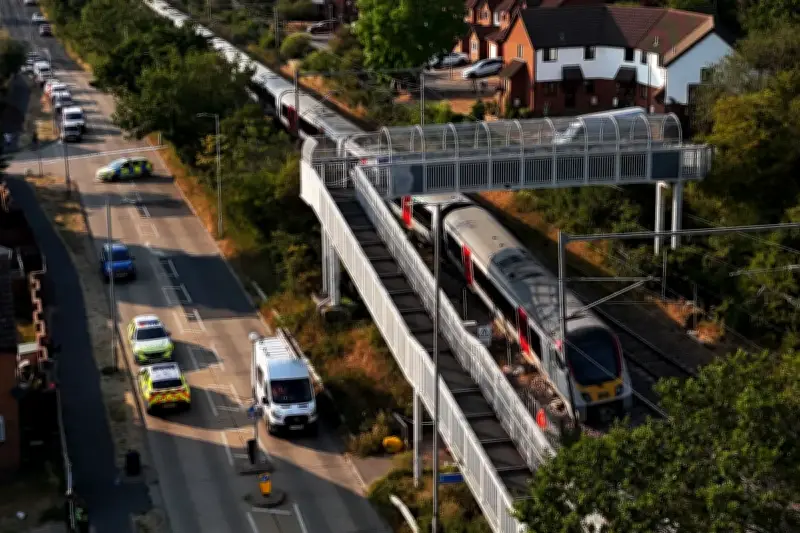
A train derailed in Essex while travelling at 77mph after its driver reported seeing a “kink” in the track, an investigation has found. The Greater Anglia service derailed south of Wickford station on August 14, with an estimated 62 passengers on board heading to London Liverpool Street.
There were no reported injuries, and the train remained upright throughout the incident. Its rear carriage derailed and was dragged across sleepers and ballast for around 1.5 miles, according to the Rail Accident Investigation Branch (RAIB) in an update on Friday.
Driver's report and black box analysis
The RAIB said the driver had been “in the process of reporting the track condition” when they braked after receiving an emergency call from another train passing in the opposite direction. Preliminary analysis of the on-train data recorder, sometimes referred to as “the black box”, showed the train was travelling at around 77mph (124 km/h) when it derailed.
“The driver reported seeing a kink in the track which rocked the driving cab as the train passed over it,” the RAIB said. “Forward-facing CCTV recovered from the train involved shows a misalignment in the track at the same location as the driver’s report and the point of derailment.”
Damage and investigation scope
The derailed train “sustained damage”, while the train passing in the opposite direction received “minor damage from flying ballast”. Investigators added: “There was significant damage caused to the track, signalling and overhead electrification equipment.”
The probe will examine factors including “the effectiveness of any mitigation measures to address the risk of operating trains in hot weather”. Events leading up to and during the derailment, the actions of those involved, the status and maintenance of the track, and the performance of the train during the incident will also be considered.
Operator response and route disruption
Jamie Burles, GBR Anglia managing director, said the company was continuing to support the investigation and added: “While the line between Wickford and Shenfield has now reopened, we are very sorry for the disruption this incident caused to our passengers and our local community. We remain thankful that no one was injured. Safety is our highest priority. Thankfully incidents like this are extremely rare on Britain’s railways which remain among the safest in the world but, when they do happen, we are determined to fully understand why.”
GBR Anglia will continue to cooperate with the investigation and consider any recommendations that may be made, he said. This follows Network Rail stating that rail passengers along the same Greater Anglia route may face longer journeys until Tuesday due to issues caused by drought and hot weather.
Network Rail said amended timetables are being introduced on the Southend Victoria to London line as well as the nearby c2c route between Shoeburyness in Essex and London, following a summer of record-breaking heatwaves. Sustained hot weather and low rainfall have caused the clay underneath long stretches of the railway in Essex to dry out and shrink, causing some issues with the quality of the track. The changes mean some journeys will take between two and eight minutes longer than usual with adjusted departure and arrival times.
The Essex derailment came less than 24 hours after two passengers were seriously injured in a separate incident where a Southern Rail service came off the tracks in East Sussex. The Lewes derailment happened on the UK’s hottest day of 2026 so far, with temperatures reaching 38.1C in west London. In its investigation into the East Sussex derailment, the RAIB noted there was “a sustained period of hot and dry weather” before the accident.