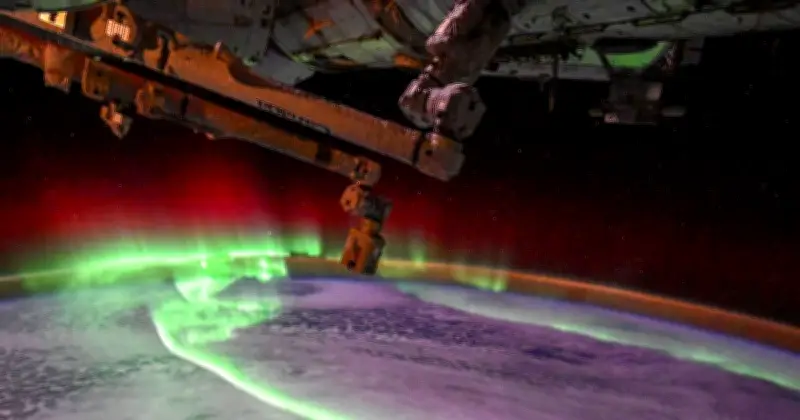
European Space Agency astronaut Sophie Adenot has described a breathtaking aurora over Earth that left the International Space Station (ISS) crew "in awe." The 43-year-old Frenchwoman shared images captured from 250 miles above Earth aboard the orbital platform on Saturday, June 20.
Aurora Dazzles Crew with Intense Green Light
Adenot said: "This aurora was absolutely spectacular. It rippled and danced beneath our feet, as far as the eye could see, and its light was so intense that it bathed the entire Station in green reflections." She added: "We've had the joy of observing several since the start of the mission, but this one - far too bright for my usual aurora photo settings - left us all in awe!"
"Moments like this never lose their magic, even up here, and the whole crew finds itself scrambling for the best spot by a window," she noted.
Science Behind the Spectacle
Auroras are spectacular natural light displays triggered by charged particles emitted from the sun as they interact with Earth's magnetic field and atmosphere. The dazzling phenomenon is generated by solar wind, a relentless stream of particles continuously discharged by the sun.
Upon reaching Earth, the vast majority of these particles are repelled by the planet's magnetic field. However, some travel along magnetic fields towards the polar regions, where they collide with oxygen and nitrogen atoms in the atmosphere, energising the gases, which in turn release their energy as vivid, glowing ribbons of light.
June Solstice and Viewing Tips
The June solstice occurred on Sunday, June 21, 2026, at precisely 4:24 a.m. EDT, heralding the beginning of astronomical summer in the Northern Hemisphere and winter in the Southern Hemisphere. It delivers the longest day of the year north of the equator and the shortest south of it.
For those hoping to catch a glimpse of the much sought-after lights, NOAA advises prospective viewers to travel northwards towards the Earth's magnetic north pole. Those situated in an area where the lights are visible should seek out an elevated vantage point, such as a hilltop, offering an unobstructed view of the sky facing north and well away from sources of light pollution. The lights are at their most active in the hours surrounding midnight, typically between 10 p.m. and 2 a.m.