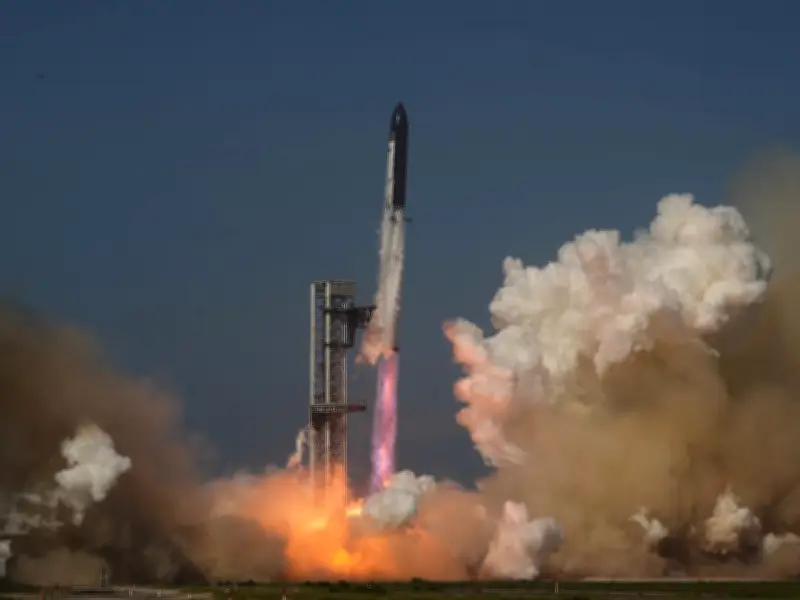
A rogue SpaceX rocket booster is on a direct collision course with the Moon and is expected to crash into the lunar surface at seven times the speed of sound this week, experts have warned. The upper-stage rocket segment will slam into the Moon on Wednesday, generating an explosive collision equivalent to detonating three tons of TNT.
Impact details
The high-speed impact near the sunlit Einstein Crater on the Moon's western limb will carve out a massive 90-foot-wide, 16-foot-deep crater, blasting a plume of dust and rubble high into space for scientists and sky-gazers to monitor.
While astronomers are not overly alarmed by the specific piece of space hardware, which launched roughly a year ago carrying a pair of lunar landers, the event highlights growing concerns over orbital congestion.

Growing concerns
Space tracking expert Bill Gray, who plans to observe the crash aftermath from New Brunswick, Canada, said: "Things are getting crowded up there."
Experts note that hitting the lunar surface was never the intention of Elon Musk's company SpaceX, but the crash could have been avoided had the upper stage been nudged into orbit around the Sun instead.
Second known accident
It marks only the second known time a defunct rocket stage has accidentally struck the Moon, following a Chinese rocket component that carved out a double crater on the lunar far side in 2022.
Although the flash of impact will last under a second and likely prove too faint to see directly, the cloud of kicked-up material could stretch for miles and remain visible to telescopes for tens of minutes.
Scientific interest
Los Alamos National Laboratory scientist Benjamin Fernando said: "The gravity on the moon is low and there is no wind to blow the dust away."
He added: "Part of the reason for our interest in this event is to figure out how much of a hazard debris impacts pose to future astronauts."
While the resulting impact site will be too small to observe from Earth, orbiting lunar probes are positioning themselves for a close-up view. NASA's Lunar Reconnaissance Orbiter alongside South Korea's Danuri orbiter will capture before-and-after imagery of the crash site.
Danuri is expected to pass within a mile or two of the incoming SpaceX rocket just two minutes prior to impact.