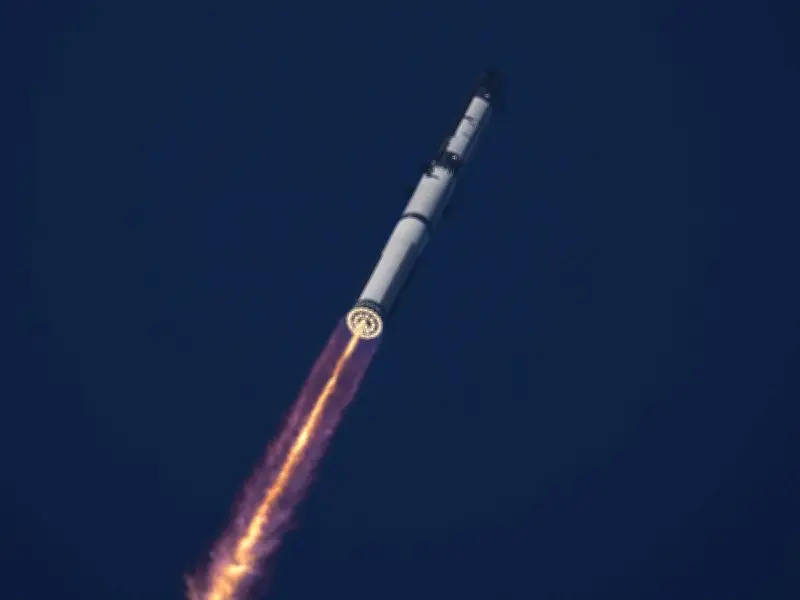
A SpaceX Falcon 9 rocket upper stage, drifting in space for over a year, is set to collide with the Moon on Wednesday (August 5), creating a crater and sending up a plume of dust and rubble that skygazers are eager to witness.
Mission Background
The Falcon 9 was launched in January 2025 as part of a US and Japanese mission to carry a pair of lunar landers and scientific equipment to the Moon. While part of the rocket is reusable and designed to return to Earth, other parts are shed in space and remain in orbit unless they eventually collide with another celestial body.
The upper stage in question is about the size of a five-storey building, with a weight on Earth of at least 4,000kg (8,800 lbs).

Predicted Impact
Space expert Bill Gray predicts the upper stage will unintentionally slam into the Moon near Einstein Crater on the Moon's sunlit western limb. The impact, at 5,400mph - seven times the speed of sound - is expected to pack the energy equivalent of three tons of TNT, carving out a crater nearly 90 feet wide and 16 feet deep while launching a plume of dust and debris miles into space.
Jimi Rusell, a spokesperson for Nasa's Centre for Near-Earth Object Studies (CNEOS), said: "There is no danger to Earth. Nasa will continue to track the booster for training purposes, as well as later observe the impact site for scientific purposes."
Previous Incidents and Observations
This will be the second dead rocket known to crash into the Moon accidentally. A Chinese rocket segment dug out a pair of craters on the lunar far side in 2022.
NASA's Lunar Reconnaissance Orbiter and South Korea's Danuri spacecraft are positioned to document the crash site on Wednesday, with Danuri expected to pass within two miles of the tumbling rocket stage just minutes before impact.
The impact will not be visible from Earth with the naked eye, but people with access to a sophisticated telescope may be able to see a flash radiating off the Moon's surface.
Concerns Over Orbital Congestion
While the collision poses no threat to Earth, experts say the incident underlines a growing concern of orbital congestion. Astronomers note the crash was avoidable had the upper stage been steered into a stable heliocentric orbit around the Sun after deploying its payload.