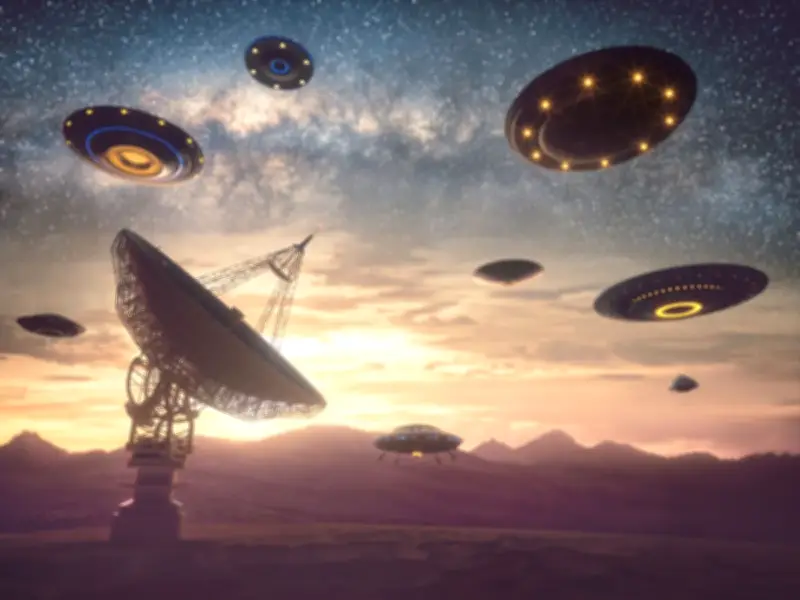
Earth has no official plan for what to do if aliens make contact, space experts have admitted, exposing a startling gap in humanity's readiness.
The absence of an agreed protocol has fuelled a fierce debate among scientists over whether humanity should be deliberately broadcasting signals into the cosmos.
Listening for signs of alien life
Humans have been listening for signals from deep space since 1959. For decades, scientists have used the Drake equation to estimate how many intelligent alien civilisations could exist in the universe.

Astronomers have been puzzled by mysterious fast radio bursts coming from distant regions of space, and NASA has detected molecules on one of Saturn's moons that could potentially point to extraterrestrial life.
A scale for alien discovery
While there is still no proof of alien life, researchers at the SETI Institute developed a tool called the Rio scale to rate potential discoveries from 0 to 10. A zero means a false alarm or observation mistake, five indicates a moderately confirmed alien signal, and ten points to undeniable direct contact or the detection of an extraterrestrial object.
Despite having no official protocol for a first-contact scenario, groups of scientists and space enthusiasts have taken matters into their own hands by broadcasting several messages deep into space. NASA packed a map of Earth onto the Pioneer spacecraft, and the Arecibo observatory in Puerto Rico beamed a radio message out into the cosmos.
Other attempts have involved blasting mathematical concepts toward star systems that could potentially host life.
Stephen Hawking's warning
The late physicist Stephen Hawking issued a chilling warning against trying to call ET. He cautioned that alien civilisations might be vastly more advanced than us and could view humanity the way we view bacteria.
Hawking repeatedly pointed to history as a grim warning, noting how contact between unequal civilisations played out for Native Americans after Europeans arrived.
Aliens may already know we are here
American astrobiologist Douglas Vakoch takes a different view. He argues that any advanced alien civilisation would have already picked up the stray radio signals Earth has accidentally been leaking into space for decades.
Whatever happens, discovering that we are not alone would change human history forever. Astrophysicist Carl Sagan believed such a monumental moment could offer 'a chance for a more humble and united humanity.'
No room for panic
The debate comes as conspiracy theorists remain obsessed with the top-secret Area 51 base in Nevada, which the US government only officially acknowledged was real in 2013.
Despite the wild theories, scientists insist that if we ever do pick up a real signal from the stars, Earth's response must be driven by hard evidence and global agreement rather than panic and guesswork.