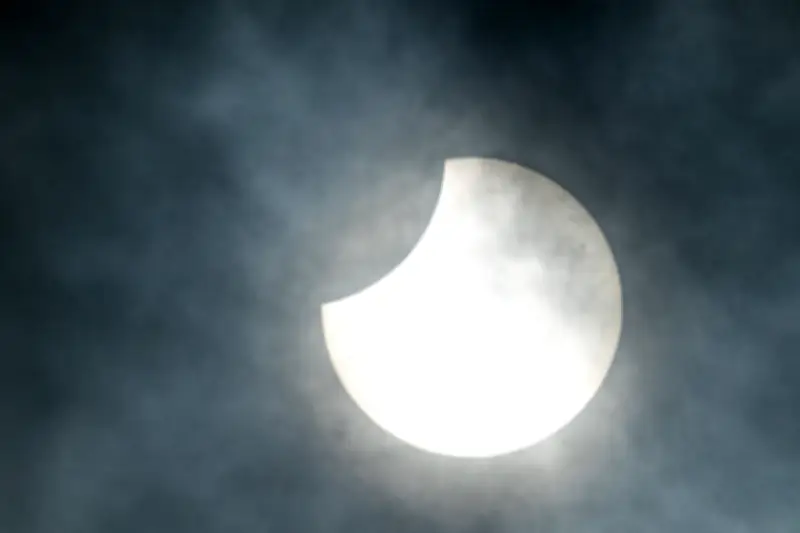
The UK will see its most complete solar eclipse in over a quarter of a century on August 12. The moon will pass directly between the Earth and the sun, blocking around 90% of the sun's light. There won't be a better eclipse in Britain until 2090.
What is a solar eclipse?
Eclipses occur when the moon blocks the sun, roughly every six months. Though the sun is some 400 times larger than the moon, it is 400 times further away. This year, the moon will almost entirely block the sun.
When is the solar eclipse?
For London, Bristol, and Cardiff, the eclipse begins at 6:17pm on August 12, with the height of the eclipse at 7:13pm. It lasts about 1 hour and 49 minutes until 8:06pm. In Manchester and Liverpool, it starts at 6:13pm, while in Scotland it begins closer to 6:08pm. Some European countries like Greenland and Iceland will experience a total eclipse.

How to watch the eclipse safely
During a partial solar eclipse, it is never safe to look at the sun without eye protection, even though it appears partially blocked. Regular sunglasses are not sufficient. Approved solar glasses must have an ISO 12312-2 international safety rating and an optical density of at least 5.0.
The Royal Observatory is livestreaming the eclipse for free. You can also check with local astronomical societies for eclipse-viewing events on August 12, or build your own pinhole projector.
Where to watch the solar eclipse in London
Apps like Eclipse Horizon Checker can help find the clearest view. High vantage points in elevated spots such as Primrose Hill and Greenwich Park are recommended.