The Moon will pass between the Sun and Earth on Wednesday, August 12, briefly blocking sunlight as Cardiff gears up for a spectacular partial solar eclipse. The Royal Greenwich Observatory has said the UK will see its most dramatic solar eclipse since 1999, with between 90 and 96 per cent of the Sun obscured by the Moon. Spectators in parts of Greenland, Iceland and northern Spain will see a total eclipse.
What time is best to see the eclipse?
In Cardiff, astronomers have said the new Moon and Sun will steadily draw closer together through the late afternoon. 'First contact' will take place at 6.17pm, when the Moon begins to cover part of the Sun. From that point, the Moon will progressively obscure more of the Sun until roughly 90 per cent coverage is reached at 7.12pm, marking the peak. At this moment, a noticeable drop in light and temperature will make conditions feel like dusk or dawn. The eclipse is expected to conclude in Cardiff at 8.06pm, nearly two hours after it began.
What are the safest ways to watch?
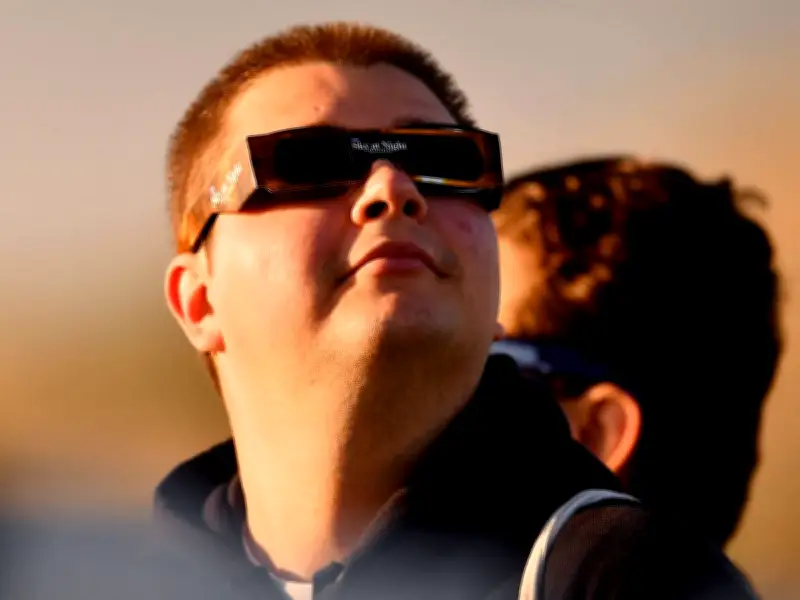
Health experts warn that looking at the eclipse directly is risky. During an eclipse, the Sun appears less bright, which can bypass the body's instinctive urge to look away and allow powerful sunlight to harm the retina. The injury happens painlessly, so damage may go unnoticed until it has already occurred. After the 1999 solar eclipse, which was total in Devon and Cornwall, around 70 people reported sight difficulties; about 40 per cent of those had looked at the Sun for under a minute, according to the Royal College of Ophthalmologists. Standard sunglasses do not provide enough protection and could be more dangerous because reduced glare makes staring at the Sun feel more comfortable, letting more damaging radiation reach the retina.

Purpose-made eclipse glasses or handheld solar viewers are the safest method. Authentic glasses can be bought from trusted retailers, with caution about online products that fail to meet standards. Alternative safe options include a pinhole viewer made at home, observing the Sun through a colander, or casting the Sun's image onto paper using a basic pinhole projector.
How does it differ from a lunar eclipse?
Both solar and lunar eclipses only occur during an 'eclipse season', when the Earth's orbit brings it nearest to the Sun. This season lasts 31 to 37 days and happens twice a year. A new Moon during this window can cast a shadow on Earth to produce a solar eclipse, while a full Moon can move into the Sun's shadow, creating a lunar eclipse. But another factor must align: the Moon orbits the Earth at an angle of about five degrees. This means most eclipses in the season are missed because new moons travel above or below the Sun from our perspective. There are short windows when the Moon aligns with the Earth's position and its view of the Sun. When this happens during eclipse season and a new Moon falls, parts of Earth see a solar eclipse. Two weeks later, if still within the window, a full Moon results in a lunar eclipse.
When will the lunar eclipse begin?
The partial lunar eclipse will start at 3.33am on Friday, August 28. It will reach its peak at 5.12am, when 90 per cent of the Moon is within Earth's shadow. The Moon will then shift away from Earth before setting and no longer being visible at roughly 6.15am. Because it is close to dawn, the Moon will be progressively low on the horizon, so an elevated spot with an unobstructed view to the southwest is recommended. As the partial eclipse approaches its peak at 5.12am, the Moon will take on a deep red hue while almost completely shrouded in Earth's shadow. This happens because Earth's atmosphere scatters blue light, leaving only red light to illuminate the Moon's surface.