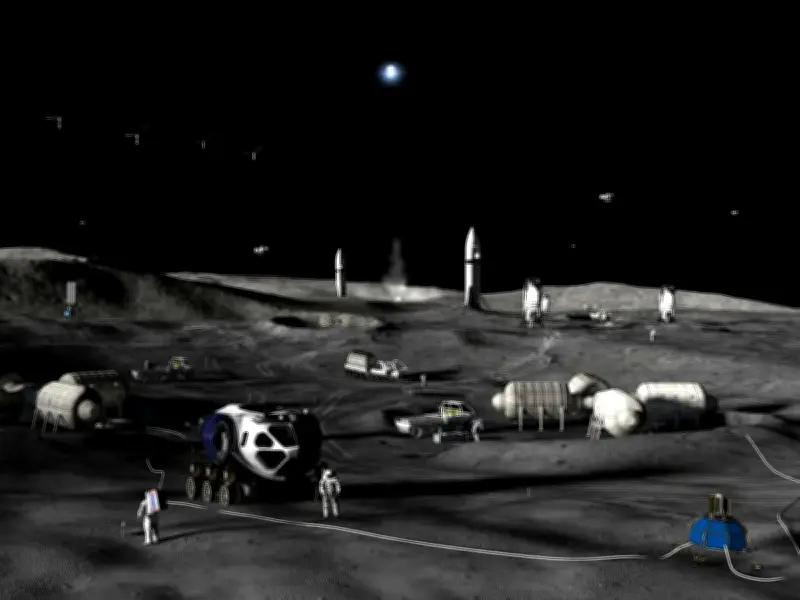
NASA administrator Jared Isaacman has said the agency is "giving a lot of thought" to meteor strikes on the lunar surface as it advances plans to establish a permanent base on the Moon. The remarks follow the revelation that a comet or asteroid the size of a building up to six storeys high crashed into the Moon in 2024, carving out a crater approximately 728 feet wide and 141 feet deep.
Scientists have described the scale of the collision as a "once-in-a-lifetime" event, which takes place roughly every century. During the Artemis II space mission earlier this year, astronauts travelling around the far side of the Moon witnessed several flashes as small space rocks, known as meteoroids, smashed directly into the lunar surface at tremendous speeds, with no atmosphere to incinerate them.
Impact on Moon base plans
Isaacman was questioned about the ramifications of the recently identified asteroid impact on the ambitious plans for a Moon base during a briefing at the Kennedy Space Centre in Florida, on Friday. He said: "Fortunately, that's a once-in-a-century type of an event, so we're fortunate in that regard. But there are much smaller meteor strikes that will happen on the lunar surface with greater frequency."
He added: "We got some additional data from that from the great crew of Artemis II and some of the observations they relayed back during their mission. So, we are giving a lot of thought to that for the Moon base."
Rovers and gradual scaling
Isaacman highlighted that a fleet of lunar rovers would be deployed to survey and chart the Moon's surface and guide the construction of the outpost. He said: "We're going to learn and we're going to gradually scale up capabilities because I guarantee you we're going to need surface improvement. It's why we're not locking in the design for habitation modules today. We're doing our science of survival, lots of uncrewed robotic landers, lots of demos, see what we like to build up to it."
He continued: "Because yes, there are going to be environmental factors we're going to need to consider that could be hazardous and be able to address them. And we will do it in a logical, iterative way to get to the right outcome."
New Glenn rocket and 2028 timeline
Isaacman also expressed admiration at the strides being made by the Blue Origin team, following its rocket's dramatic explosion on the launchpad. The spaceflight firm has a pivotal role to play from the very beginning in the Moon base proposals. The project relies heavily on the heavy-lift New Glenn rocket, which blew up during an engine-firing test at the end of May.
Isaacman said: "I think they've been very open about targeting the end of the year... they are moving with purpose. So, whether they hit December or they wind up in January, they're breaking everyone's records."
When pushed on whether he would "put money" on landing astronauts on the Moon in 2028, Isaacman said: "We are putting taxpayer money on it, but we are doing so in the most efficient, responsible way we possibly can in that regard." He conceded that "a monumental effort is ahead" and continued: "We are very eyes wide open to what needs to be done, and what needs to be done is to get ready to launch Artemis III. And, in parallel, we need to launch a lot of Moon-based missions." He further stated: "This is an achievable path we are on right now. We have the mandate, we have the resources, the support from our stakeholders to be able to execute, and that's what we intend to do."