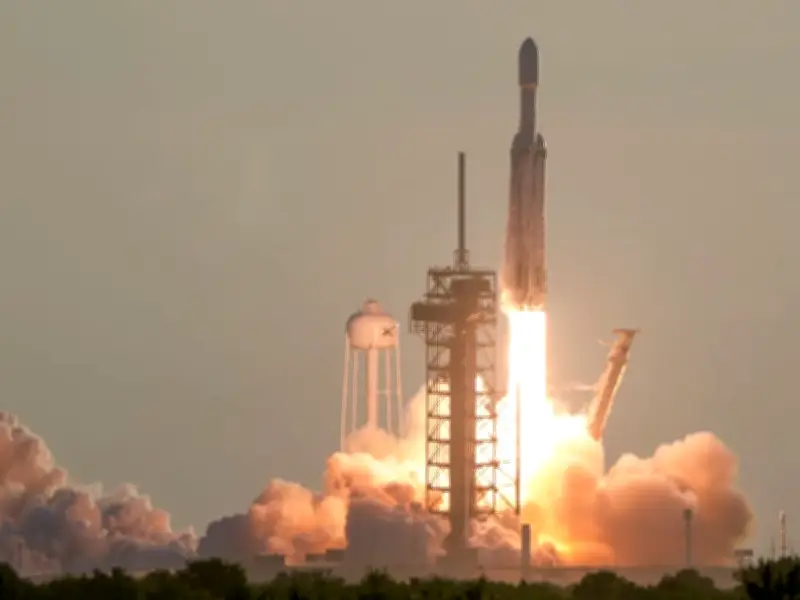
NASA's Roman Space Telescope, a bus-sized observatory, launched on Sunday, August 30, aboard a SpaceX Falcon Heavy rocket from Kennedy Space Centre. The $4.3 billion mission is designed to hunt for planets around other stars and uncover things scientists have "never been able to do before," according to a NASA director.
The telescope is heading toward an observation point one million miles away, the same location as the Webb Space Telescope. Named after Nancy Grace Roman, NASA's first chief astronomer, it will take more than three months to reach its destination.
Unprecedented Field of View
Once in position, Roman will cast the widest gaze yet on the hidden parts of the universe. NASA science mission director Nicky Fox said: "It's going to find thousands of supernovae, tens of thousands of planets, billions of galaxies and tens of billions of stars. It's going to be able to do things that we've never been able to do before with its massive field of view."

Roman's field of view is more than 100 times wider than that of NASA's Hubble Space Telescope, which has been operating for 36 years. The James Webb Telescope, with its narrower but more sensitive vision, can zoom in on objects almost as old as the Big Bang.
Collaborative Space Observatories
These three orbiting devices will work together, along with the European Space Agency's Euclid spacecraft and the National Science Foundation's Vera C. Rubin Observatory in Chile, to reveal some of the universe's biggest secrets. Once Roman spots new worlds, the more powerful Webb will take aim to fill in the blanks.
Senior project scientist Julie McEnery said: "Roman's vast reach will allow us to find the weird, the rare and the unusual. We'll redefine what it means to find a needle in a haystack."
Probing Dark Matter and Dark Energy
Astronomers also expect Roman to shed light on dark matter and dark energy, which make up most of the universe yet remain concealed. Roman's catalogue of galaxies will help scientists determine how quickly the universe is expanding due to these unseen forces.
Roman's speed is a key advantage. A month of Milky Way observations by Roman would take Hubble a century to complete, according to McEnery. The telescope should quickly scan the galactic bulge at the centre, providing the deepest look yet into the heart of our galaxy.
Besides a wide-field infrared camera that matches Hubble's sensitivity but is 1,000 times faster, Roman holds an instrument to block out starlight. This experimental, eclipse-creating coronagraph will allow Roman to directly image any planet, however faint, orbiting the masked star.
The telescope is designed to be refuelled, meaning a robotic tanker could extend its life if available in the coming decade. Launching nearly a year ahead of schedule and within budget, Roman is NASA's first space telescope named after a woman.