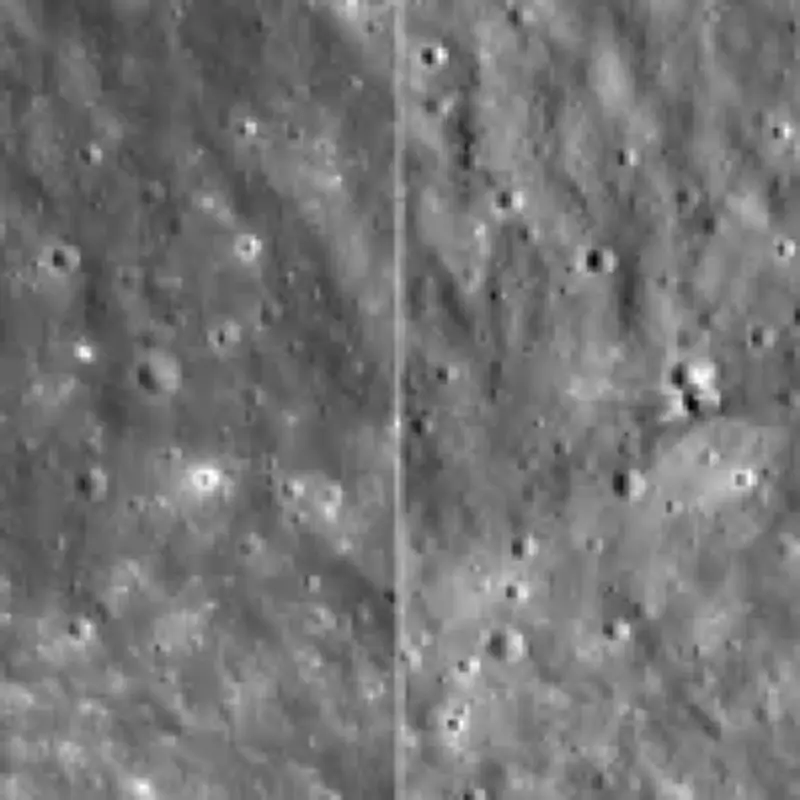
New images released by NASA have revealed how a discarded rocket stage punched a fresh crater into the surface of the Moon. The images, captured on August 11 and 12, show the impact site with a dark scar and pale streaks of debris where the ground had previously been undisturbed.
Crater Formation and Details
NASA said in a statement: “Our Lunar Reconnaissance Orbiter (LRO) has captured images of a new crater on the Moon. The crater formed on Aug. 5, 2026, when a SpaceX Falcon 9 upper stage impacted the lunar surface.” The stage had been left in space after lifting the Firefly Blue Ghost 1 mission off the launch pad in January 2025.
Engineers tilted the orbiter on its side so that its cameras faced the new crater while the camera flew past at around 60 miles per hour overhead. Because the lunar orbiter circles from pole to pole every two hours while the Moon turns slowly beneath, the team had to wait six days for the site to rotate into view. A camera shutter firing ten seconds early or late would have thrown the target around 10 miles off target.

Impact and Observations
The Narrow-Angle Camera, capable of picking out objects less than a metre across, put the crater at 60 feet wide and ten feet deep. The streaks stretching out from the crater were formed by solar wind, cosmic rays and micrometeorite strikes.
Dr Ed Bloomer, an astronomer at the Royal Observatory Greenwich in London, told Metro that the piece of space junk didn’t have the capability to seriously damage the moon. He says that even British stargazers might be able to catch the rather permanent aftermath of the lunar smash.
Space Debris Context
SpaceX is behind an increasing amount of space junk, given it conducts half of all global launches, Accu Component’s space race report found. For Dr Bloomer, the skies above our heads are becoming a stellar dumping ground – Wednesday’s rocket smash won’t be the last.
A Chinese rocket segment dug out a pair of craters on the moon’s far side, sometimes called the dark side, in 2022. NASA’s Lunar Crater Observation and Sensing Satellite, meanwhile, fell onto that same side in 2009.