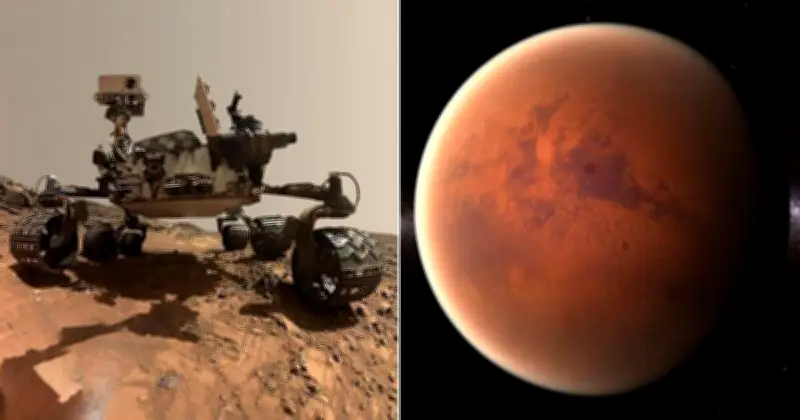
NASA's Curiosity rover has made a startling discovery while traversing Mars in mid-June, revealing a distinctive honeycomb-like pattern on the planet's surface. The space agency disclosed the find in a statement released in late July.
The rover captured remarkable images on 19th and 20th June that showed the pattern, scientifically termed "polygonal fractures." These formations were found in a Martian valley called Valle Grande and measured 1.5 to 3 inches. This discovery comes more than a decade into Curiosity's mission to explore Mars.
Unique Formation Baffles Scientists
NASA acknowledged that the rover has uncovered similar geometric formations previously, but this particular pattern is unfamiliar to the scientific community. Project scientist Ashwin Vasavada of NASA's Jet Propulsion Laboratory expressed astonishment, saying, "We've seen a lot of fascinating landscapes through Curiosity's eyes, but this sea of polygons took our breath away. We measured their shapes and chemistry carefully and are hopeful there are clues in the data as to how these features formed."

The "polygonal fractures" extend as far as Curiosity can observe from a steep hill named Miraflores. The origins of the discovery remain a mystery, NASA acknowledges, but emerging scientific theories suggest that temperature fluctuations could have caused water to penetrate through the sedimentary layers of Mars' surface. However, scientists warn that further research is needed before definitive conclusions can be drawn.
Past Discoveries and Implications
Previously, NASA had identified polygons in the shape of mud cracks. The agency noted in its July 29 statement, "Some of the polygons that the mission has spotted in the past clearly formed as mud cracks, though a variety of processes can contribute to their honeycomb textures, including cycles of warm and cold temperatures or compression that squeezed water out of the sediment when the surface was buried."
These newly discovered polygons are among many surprises Curiosity has encountered since landing on Mars 14 years ago, on Aug. 5, 2012. The rover has made major discoveries about the ancient Martian environment, including evidence that it had the water, chemistry, and nutrients to support microbial life. NASA added that billions of years ago, lakes and streams dappled the lower foothills of Mount Sharp, a 3-mile-tall mountain Curiosity has been ascending since 2014.
The rover has previously uncovered chemistry left over from Mars' watery history, including carbon-based molecules believed to be precursors to RNA and DNA. NASA stated, "Scientists have no way of knowing whether these organic molecules were created by biologic or geologic processes - either path is possible - but their discovery reconfirmed that ancient Mars had the right chemistry to support life."