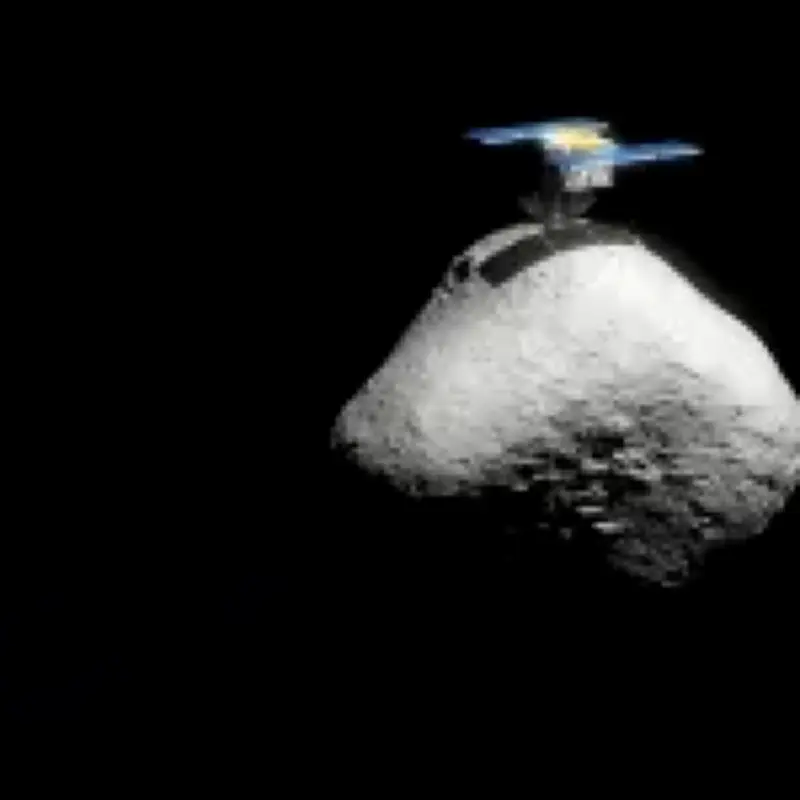
A mystery object about 36ft in length that was thought to be an asteroid is accelerating as it heads toward Earth, and a Harvard professor has suggested it may actually be a long-lost Soviet spacecraft.
Research by the Georgia Institute of Technology found that the object, known as 1998 KY26, is speeding up due to something other than gravity. It spins once every 5.35 minutes and is currently around 189 million miles from Earth.
Close approaches in 2028 and 2039
According to the European Space Agency, 1998 KY26 will come within 32 million miles of Earth in 2028, and in 2039 it will be even closer at less than 10 million miles.
Harvard Professor Avi Loeb has argued that the object is not a piece of space rock but a lost spacecraft. He theorised that it is Phobos 1, which was launched by the Soviet Union in 1988 but disappeared months into its journey to Mars.
Unusual acceleration detected
1998 KY26 was discovered to be moving faster than normal in 2023, after 25 years of telescope data collection. Aerospace engineers Korbin Hansen and Masatoshi Hirabayashi concluded that the speed is not the result of any natural phenomenon.
“We determined that 1998 KY26 is likely a dehydrated asteroid,” they wrote in the study.
One “dark comet” theory suggested that there was hidden ice inside the asteroid that was slowly turning into gas, giving it a little push. However, no tail or dust cloud could be seen, and it has been reported that 1998 KY26 is too warm to carry ice through space, sitting around -53°F to -78°F or warmer.
Solar radiation pressure theory
Loeb and co-authors Adam Hibberd and Adam Crowl argued that the size, shape and odd speed of the so-called space rock point to a manmade object. The physicist proposed that the Sun's energy on Phobos 1's shiny metal surfaces and solar panels is creating a condition known as solar radiation pressure.
“The similarity of the orbit of 1998 KY26 to the orbit of the lost Phobos 1 spacecraft suggests that the two objects are the same,” Loeb said in a statement.
In 2031, a Japanese probe is set to intercept the mystery debris and become the first spacecraft to make contact with and study a space object that small. “Our prediction is that instead of an iceberg, Hayabusa 2's cameras will reveal the label 'Made in the U.S.S.R.',” the professor added.