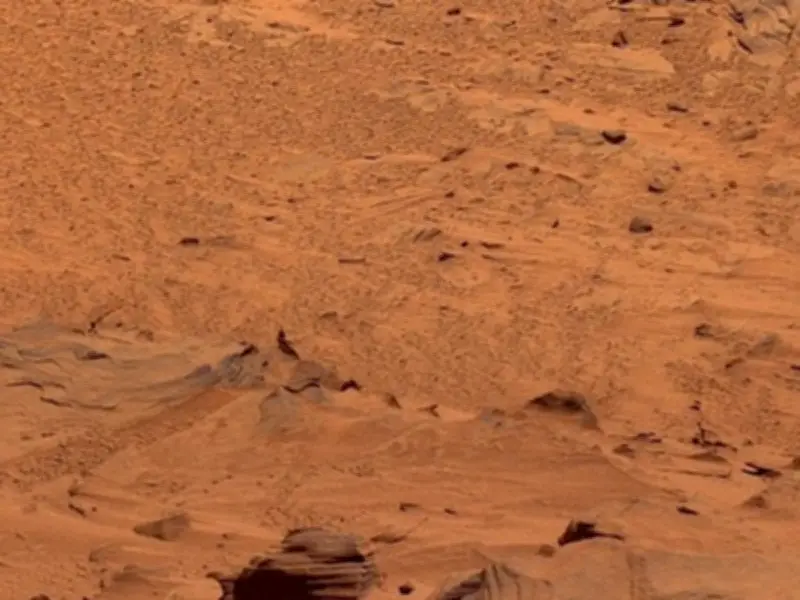
A resurfaced NASA photo has ignited online speculation after eagle-eyed viewers spotted what looks like a humanoid figure on the Martian surface. The image, originally captured by NASA's Spirit rover in November 2007, shows a strange shape among rocks that appears to have arms outstretched and one leg forward, as if caught mid-stride.
Internet reacts to 'Mars Bigfoot'
The phenomenon, dubbed "Mars Bigfoot," tends to resurface whenever it trends on social media. Reactions online are mixed. One Reddit user dismissed it: "I'm sorry but this looks like some shadow that could be from anything and I do think UFOs are totally real (aliens too)." Others were more convinced, with one insisting, "That's Bigfoot!" and another adding, "This is it, I'm convinced (of what I have no idea)." A quip read: "Bigfoot had enough of earth and rednecks," while another dubbed the creature "Marsquatch."
What the photo really shows
Despite the wild claims, the photo is authentic. Spirit took it at a site called "Home Plate" inside Gusev Crater, a bleak landscape of volcanic rocks and dust. In the original, uncropped image, the object is tiny—a rock formation just 6 centimetres (around 2 inches) tall. The dramatic effect comes from zooming and cropping, which destroys the sense of scale.

Scientists attribute the illusion to pareidolia, the brain's tendency to see familiar shapes in random patterns, as reported by Space. After erosion by harsh Martian winds over vast timescales, the rock happens to resemble a bipedal silhouette.
Life on Mars?
Life as we know it is not currently possible on Mars. Scientists think microscopic life may have existed billions of years ago when the planet was warmer and wetter, according to Teach Astronomy. Today's Mars is an extremely hostile desert that would quickly kill any Earth organism.
One of the biggest problems is the atmosphere. The air is about 100 times thinner than Earth's and is roughly 95% carbon dioxide, with almost no oxygen, per the Robot Report. With such low air pressure, liquid water cannot remain stable on the surface; it would boil away or freeze almost instantly.
Mars is also farther from the Sun and lacks a thick atmosphere to retain warmth, making it a frozen wasteland. The average surface temperature is around minus 62°C, and at the poles it can plunge to a deadly -140°C.