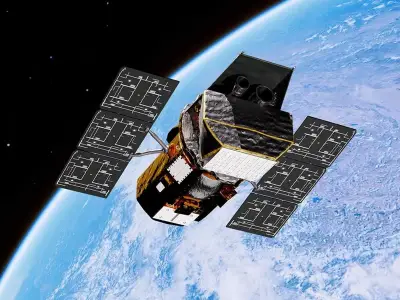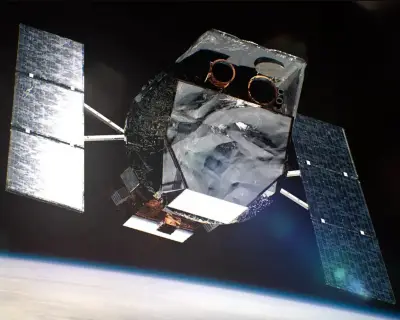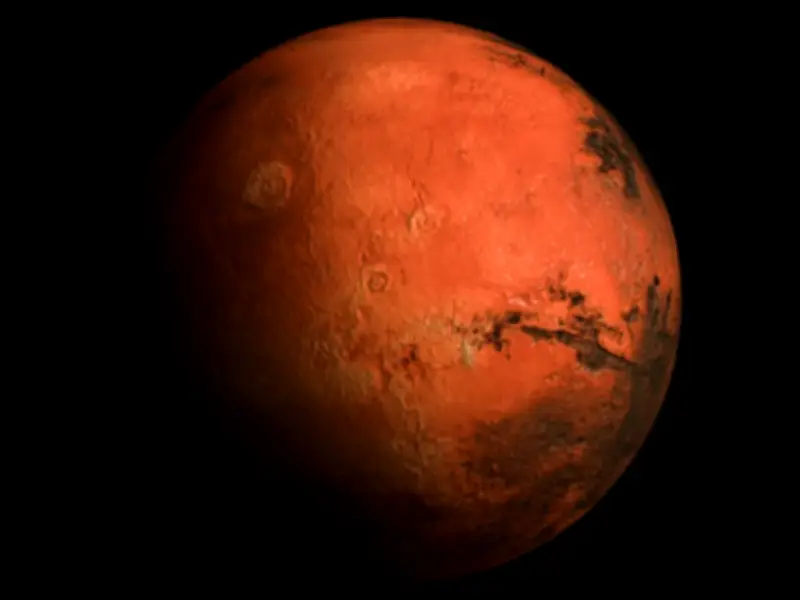
Gas seeping above volcanic rifts on Mars, detected by a European Space Agency (ESA) orbiter, suggests the planet is not geologically dead deep inside but merely sleeping, according to scientists. The new evidence points to the possibility of life on the red planet.
Fresh fissures along the Alba Mons region hint at active spots under the surface, where gases from inside the planet may be making their way up to the surface. An international research team believe that the release of hydrogen chloride comes from hot magma beneath the surface, a sign of dormant volcanism.
Detection of hydrogen chloride
The ExoMars Trace Gas Orbiter (TGO) first reported hydrogen chloride gas in the Martian atmosphere in 2021. The gas is commonly found escaping from magmatic vents on Earth, leading researchers to wonder whether the same was happening on Mars.
Researchers first noticed, in early summer in the northern hemisphere of Mars, spikes of hydrogen chloride where it shouldn't have been, and during an odd season. The gas varies seasonally on Mars, reaching its maximum in northern hemisphere winter, then mostly disappearing in the summer, according to study co-leader Professor Daniel Mege. Most of the variability appears to be linked with Mars' dust and water cycles.
Volcanic fissures and the smoking gun
But there was one exception to the pattern, always in the same season and at the same place, above volcanic fissures on the flanks of the Alba Mons volcano, in early summer. The infrared spectrometers from TGO's Atmospheric Chemistry Suite detected hydrogen chloride strongly localised in space and at a time just after the frosts of winter sublimate. A close look at the Alba Mons region using TGO's CaSSIS camera showed fresh and narrow fissures, in some cases hundreds of metres long, associated with colour changes on the surface.
Prof Mege, from the Space Research Centre of the Polish Academy of Sciences, said: "The Trace Gas Orbiter was able to find the smoking gun. It was like looking for a needle in a haystack. It's truly amazing that it spotted a handful of molecules from a perhaps intermittent source, whilst moving continuously along its orbit to monitor the whole Martian atmosphere."
Implications for Martian life
Scientists suggest magmatic gases might be rising through the fissures. Blocked by ice during winter's freezing temperatures, down to -120C, the fissures would channel the release of chloride as the ice sublimates in early summer. The research team believe the discolouration around the fissures could come from deposits left behind by gases escaping from Mars's interior.
The team suggests that the seepage is connected to a dormant magma chamber, a type of volcanic "plumbing system" under the Martian surface. Researchers say magmatic gases such as hydrogen chloride could have been more abundant in the past, contributing to a thicker atmosphere and warmer climate and allowing liquid water to cover much of the Martian surface. If lava rising through the crust meets groundwater, the researchers say it could lead to warm habitable niches.
Prof Mege said: "Looking for Martian life in the seeping fissures of the Alba Mons region would make a lot of sense. If hydrothermal systems are active, they could contain the ingredients and energy needed for microorganisms to develop, and shield microorganisms from the hostile and changing environment above the surface." The findings are published in the journal Science Advances. Dr Colin Wilson, European Space Agency project scientist for the ExoMars TGO, added: "These findings may prove to be TGO's greatest success yet."