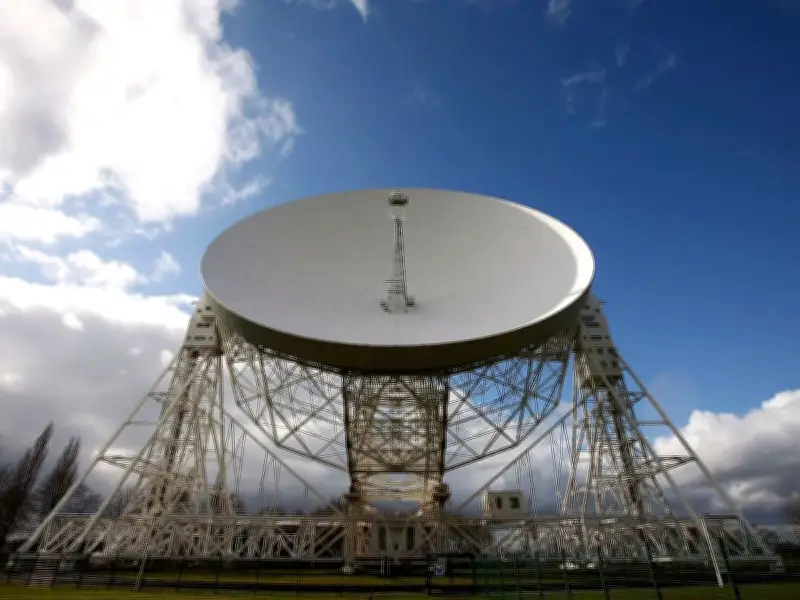
Jodrell Bank Observatory, home to the iconic Lovell telescope, has been at the forefront of groundbreaking astronomical discoveries, including the recent detection of hidden black holes. However, its future is now uncertain after the government announced that funding will end in March 2028.
Recent Discoveries
Just weeks before the funding cut was announced, the E-Merlin network, which the Lovell telescope is part of, revealed scores of previously hidden black holes in our universe. An international team led by Dr David Williams-Baldwin from Manchester University studied 280 nearby galaxies and found faint traces of black holes at the center of almost a quarter of them.
Dr Williams-Baldwin attributed the findings to the remarkable capabilities of the E-Merlin network. "When we connect up all seven telescopes it provides an image sharpness which is the same as the Hubble telescope," he said. "We can see right into the centres of these galaxies."

Decade of Breakthroughs
This is just the latest in a series of groundbreaking discoveries. In 2017, the network detected the radio afterglow of a neutron star merger. In 2022, scientists witnessed one of the largest explosions ever observed, a gamma-ray burst 2.4 billion light-years away that affected Earth's atmosphere. Last year, it observed one of the first intermediate-sized black holes ever discovered.
The Lovell telescope is also being used to track satellites and space debris in Earth's increasingly congested orbit, helping to make space safer.
Campaign to Save Jodrell Bank
The funding cut has sparked a huge backlash from the public and scientists. The Manchester Evening News is fighting to save the site, with more than 5,000 people signing a petition calling on the government to reverse its decision. An open letter signed by 200 scientists and celebrities warned that closing Jodrell Bank would "poke out some of the world's clearest eyes on the sky."